
Introduction
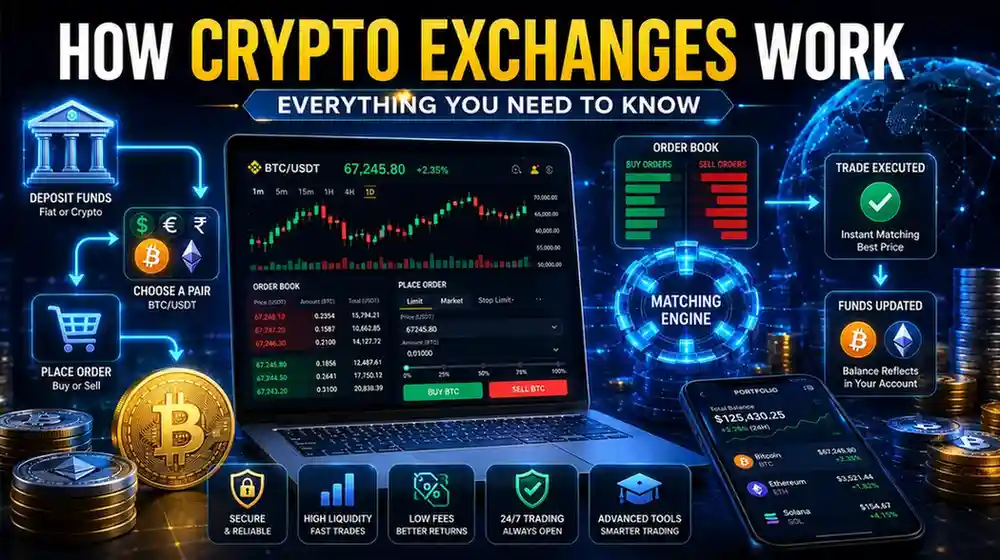
If you’ve ever wondered how people buy Bitcoin, trade Ethereum, or invest in thousands of other cryptocurrencies, the answer almost always begins with a crypto exchange. These online platforms have become the backbone of the digital asset economy, allowing millions of users worldwide to buy, sell, trade, and store cryptocurrencies with just a few clicks.
However, many beginners don’t fully understand what happens behind the scenes. When you place a buy order, who sells you the cryptocurrency? How is the price determined? What role does liquidity play? And most importantly, how do crypto exchanges keep your funds secure?
In this comprehensive guide, you’ll learn exactly how crypto exchanges work, the technology behind them, the different types of exchanges, and what you should know before creating your first trading account.
Article Overview
By the end of this guide, you’ll understand:
- What a cryptocurrency exchange is
- How crypto exchanges process buy and sell orders
- The differences between centralized and decentralized exchanges
- Why liquidity and order books matter
- The fees charged by exchanges
- How exchanges protect user funds
- Common risks every beginner should know
- Tips for choosing the right exchange
Whether you’re buying your first Bitcoin or planning to become an active trader, understanding how exchanges operate will help you make smarter and safer investment decisions.
What Is a Crypto Exchange?
A crypto exchange is an online marketplace where users can buy, sell, and trade digital currencies. Think of it as the cryptocurrency equivalent of a stock exchange—but instead of trading company shares, you’re trading digital assets such as Bitcoin, Ethereum, Solana, or thousands of other cryptocurrencies.
A crypto exchange connects buyers with sellers and provides the technology needed to execute trades quickly and securely.
Most exchanges also offer additional services, including:
- Cryptocurrency wallets
- Spot trading
- Margin trading
- Futures trading
- Staking rewards
- Crypto lending
- Portfolio tracking
- Mobile trading apps
Without crypto exchanges, buying or selling cryptocurrencies would be far more difficult because users would have to find trading partners manually.
Why Crypto Exchanges Are Important
Crypto exchanges are the foundation of today’s digital asset ecosystem. They make cryptocurrencies accessible to everyday users by simplifying the buying and selling process.
Some of their key roles include:
- Providing market liquidity
- Discovering fair market prices
- Enabling instant transactions
- Supporting multiple cryptocurrencies
- Offering secure storage options
- Connecting global buyers and sellers
- Supporting fiat currency deposits and withdrawals
As cryptocurrency adoption continues to grow worldwide, exchanges play an increasingly important role in connecting traditional finance with blockchain technology.
How Does a Crypto Exchange Actually Work?
At its core, every crypto exchange performs one primary task:
It matches buyers who want to purchase cryptocurrency with sellers who want to sell it.
The exchange itself usually doesn’t decide the market price. Instead, prices are determined by supply and demand.
Here’s a simplified example:
- Rahul wants to buy 1 Bitcoin at $100,000.
- Priya wants to sell 1 Bitcoin at $100,000.
- The exchange’s matching engine detects that the prices match.
- The trade is executed automatically within seconds.
- Bitcoin is transferred to Rahul’s exchange wallet.
- The payment is credited to Priya’s account after deducting the applicable trading fee.
This automated process happens millions of times every day across the world’s leading cryptocurrency exchanges.
Behind the Scenes: The Main Components of a Crypto Exchange
Although exchanges appear simple on the surface, several systems work together behind the scenes.
1. User Accounts
Every trader begins by creating an account.
Most regulated exchanges require users to:
- Register with an email address
- Create a secure password
- Enable two-factor authentication (2FA)
- Complete identity verification (KYC)
- Link a bank account or payment method
Once verified, users can deposit either fiat currency (such as USD, EUR, or INR) or cryptocurrency into their exchange account.
2. Digital Wallets
Every exchange provides wallets where users can temporarily store their cryptocurrencies.
Wallets generally fall into two categories:
Hot Wallets
- Connected to the internet
- Enable instant trading
- Faster withdrawals
- More convenient
- More exposed to cyber threats
Cold Wallets
- Stored offline
- Much harder for hackers to access
- Used to protect the majority of customer funds
- Preferred for long-term security
Most reputable exchanges keep only a small portion of assets in hot wallets while storing the majority in cold storage.
3. Trading Engine
The trading engine is the brain of a crypto exchange.
It is responsible for:
- Matching buyers and sellers
- Executing trades
- Updating market prices
- Managing open orders
- Calculating balances
- Recording completed transactions
Modern trading engines can process thousands—or even millions—of orders per second with extremely low latency.
Types of Crypto Exchanges
Not every crypto exchange operates the same way. Understanding the different types can help you choose the platform that best fits your goals.
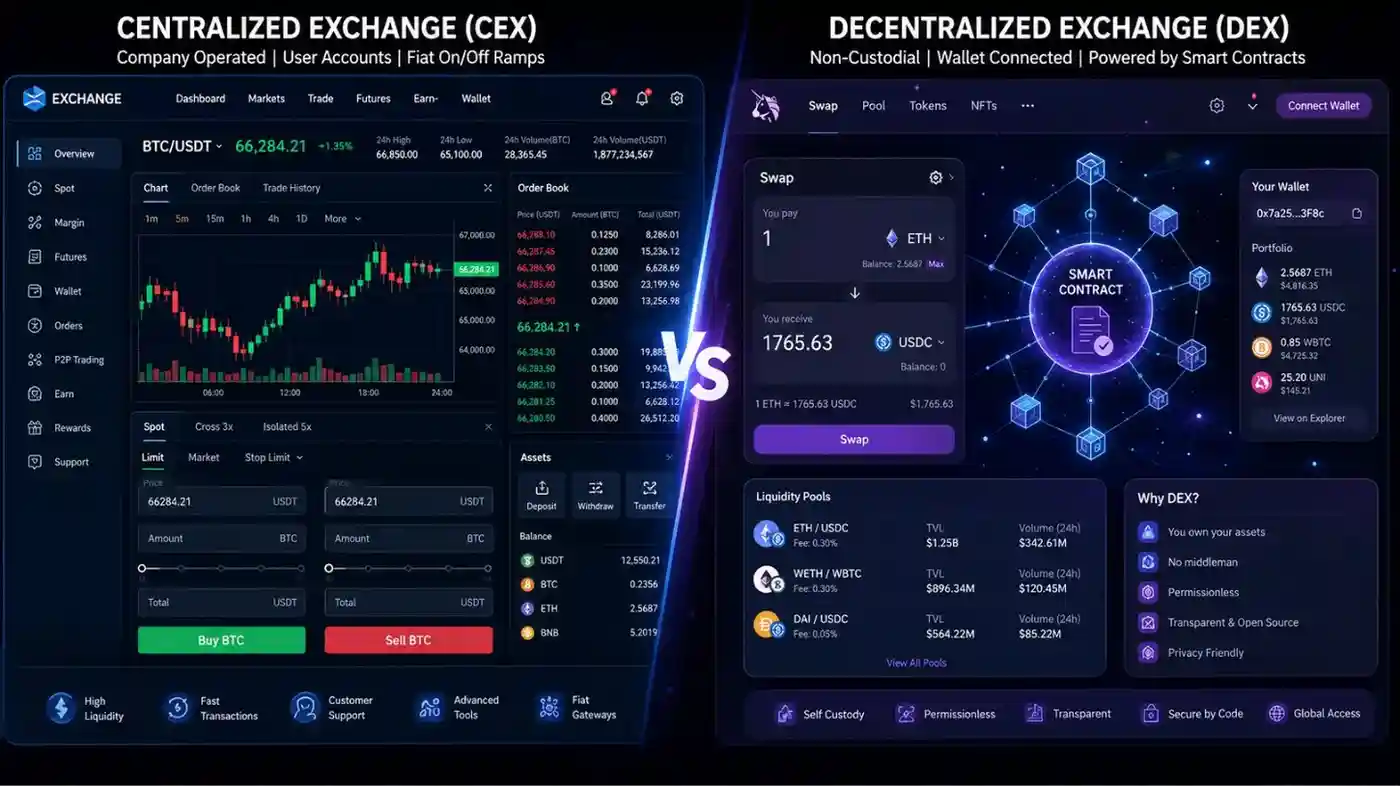
1. Centralized Exchanges (CEX)
Centralized exchanges are the most popular option for beginners. A company manages the platform and acts as an intermediary between buyers and sellers.
Examples include:
- Binance
- Coinbase
- Kraken
- Bybit
- OKX
Advantages
- Beginner-friendly interface
- High liquidity
- Fast transactions
- Customer support
- Fiat deposits
- Advanced trading tools
Disadvantages
- Users don’t control private keys while funds remain on the exchange.
- Identity verification is usually required.
- Platforms may become targets for hackers.
2. Decentralized Exchanges (DEX)
Decentralized exchanges eliminate intermediaries by allowing users to trade directly from their crypto wallets using smart contracts.
Popular DEX platforms include:
- Uniswap
- PancakeSwap
- Curve Finance
- SushiSwap
Instead of depositing funds into an exchange account, users retain full control of their assets throughout the trading process.
Advantages
- Full ownership of crypto assets
- No centralized custody
- Greater privacy
- Permissionless access
- Supports decentralized finance (DeFi)
Disadvantages
- Less beginner-friendly
- Gas fees can be high
- Limited customer support
- Greater responsibility for wallet security
Centralized vs. Decentralized Exchanges
| Feature | Centralized Exchange | Decentralized Exchange |
|---|---|---|
| Custody | Exchange holds assets | User holds assets |
| KYC | Usually required | Usually not required |
| Trading Speed | Very fast | Depends on blockchain |
| Liquidity | High | Varies by protocol |
| Customer Support | Available | Community-based |
| Best For | Beginners | Experienced crypto users |
How Crypto Exchanges Work: A Step-by-Step Process
Now that you understand what a crypto exchange is, let’s explore what actually happens behind the scenes when you buy or sell cryptocurrency. While the process may seem instant from a user’s perspective, several systems work together within seconds to complete every trade.
Step 1: Create an Account
The first step is registering on a cryptocurrency exchange. Most centralized exchanges require users to:
- Sign up with an email address or mobile number
- Create a strong password
- Enable Two-Factor Authentication (2FA)
- Complete Know Your Customer (KYC) verification
- Link a bank account, debit card, or other payment method
Identity verification helps exchanges comply with financial regulations and reduce fraud, money laundering, and other illegal activities.
Step 2: Deposit Funds
Once your account is verified, you need to fund it before you can trade.
Most exchanges allow deposits through:
- Bank transfers
- Debit or credit cards
- UPI (where supported)
- Peer-to-Peer (P2P) transfers
- Cryptocurrency transfers from another wallet
For example, if you deposit ₹10,000 into your exchange account, that balance becomes available for purchasing cryptocurrencies such as Bitcoin or Ethereum.
Step 3: Choose a Trading Pair
Cryptocurrencies are traded in pairs.
Examples include:
- BTC/USDT
- ETH/USDT
- SOL/USDT
- BTC/INR
- ETH/BTC
A trading pair shows which asset you’re buying and which asset you’re paying with.
For instance:
- BTC/USDT means you’re buying Bitcoin using Tether (USDT).
- BTC/INR means you’re buying Bitcoin using Indian Rupees.
Step 4: Place an Order
After selecting a trading pair, you’ll choose the type of order you want to place.
Market Order
A market order buys or sells cryptocurrency immediately at the best available market price.
Best for:
- Beginners
- Fast execution
- Highly liquid markets
Example:
You decide to buy Bitcoin immediately. The exchange automatically matches your order with the lowest-priced seller available.
Limit Order
A limit order allows you to specify the exact price you’re willing to pay.
Example:
Current Bitcoin price: $100,000
You want to buy only if Bitcoin drops to $98,000.
Your order remains open until:
- The price reaches $98,000, or
- You cancel the order.
Limit orders give traders more control over execution but may not fill immediately.
Stop Orders
More experienced traders often use stop orders to manage risk.
Examples include:
- Stop-loss orders
- Stop-limit orders
- Take-profit orders
These orders automatically trigger when the market reaches a predefined price, helping traders protect profits or limit losses.
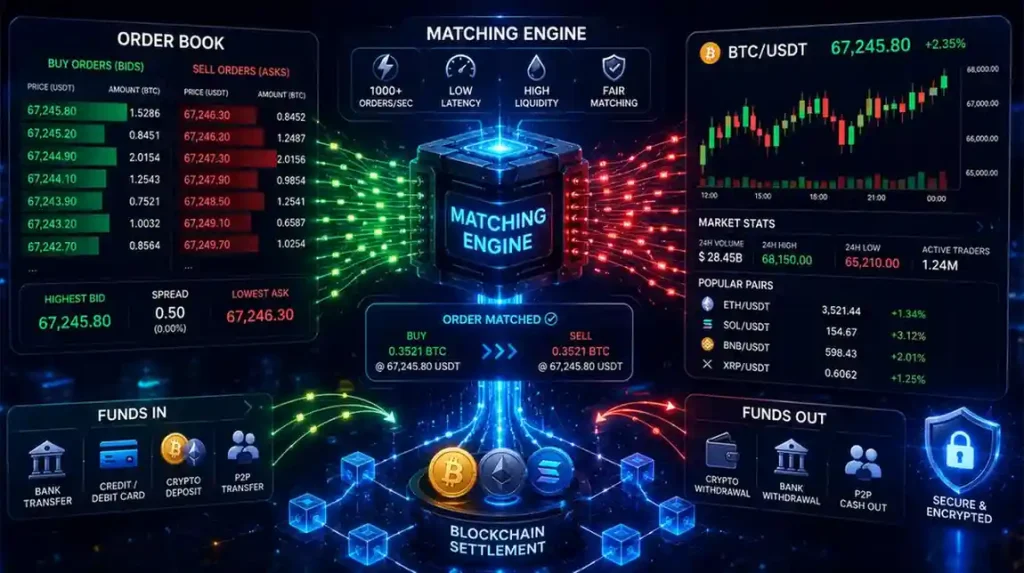
The Order Book Explained
An order book is one of the most important components of any crypto exchange.
It displays all active buy and sell orders that have not yet been executed.
A typical order book contains:
Buy Orders (Bids)
These represent traders who want to purchase cryptocurrency at specific prices.
Example:
| Price | Amount |
|---|---|
| $99,900 | 2 BTC |
| $99,850 | 1.5 BTC |
| $99,800 | 3 BTC |
Sell Orders (Asks)
These represent traders willing to sell at specific prices.
Example:
| Price | Amount |
|---|---|
| $100,000 | 1 BTC |
| $100,050 | 2 BTC |
| $100,100 | 4 BTC |
When the highest bid matches the lowest ask, the exchange’s matching engine executes the trade automatically.
What Is the Matching Engine?
The matching engine is the core technology behind every cryptocurrency exchange.
Its job is to:
- Match buyers with sellers
- Process thousands of trades per second
- Update prices in real time
- Prevent duplicate orders
- Maintain market fairness
- Record completed transactions
Leading crypto exchanges use ultra-low-latency matching engines capable of processing millions of transactions every second.
This technology is one of the main reasons modern exchanges can handle heavy trading activity without significant delays.
How Are Cryptocurrency Prices Determined?
Many beginners assume exchanges set cryptocurrency prices.
In reality, prices are determined by supply and demand.
Example
Suppose:
- Hundreds of people want to buy Bitcoin.
- Only a small number of people are willing to sell.
Demand becomes greater than supply.
As competition among buyers increases, Bitcoin’s price rises.
On the other hand:
- If more investors are selling than buying,
- Sellers compete by offering lower prices,
- The market price falls.
This continuous interaction between buyers and sellers creates the live market price displayed on exchanges.
What Is Liquidity?
Liquidity refers to how easily an asset can be bought or sold without causing a significant change in its price.
A market with high liquidity has:
- Many buyers
- Many sellers
- Tight bid-ask spreads
- Fast order execution
- Stable prices
A market with low liquidity often experiences:
- Slower trade execution
- Larger price swings
- Higher slippage
- Wider bid-ask spreads
Bitcoin and Ethereum generally have high liquidity because they attract large numbers of active traders worldwide.
Smaller cryptocurrencies may have lower liquidity, making them more volatile.
Understanding Slippage
Slippage occurs when your trade executes at a different price than expected.
For example:
You place a market order to buy Bitcoin at $100,000.
Before your order is fully executed, the available sellers at that price run out.
The remaining portion of your order fills at $100,080.
The $80 difference is known as slippage.
Slippage is usually minimal in highly liquid markets but can become significant during periods of extreme volatility or when trading low-volume tokens.
Trading Fees Explained
Crypto exchanges generate revenue by charging fees for their services.
Common fees include:
Trading Fees
Charged whenever you buy or sell cryptocurrency.
Usually range between:
- 0.02%
- 0.10%
- 0.25%
- 0.50%
depending on the exchange and your trading volume.
Deposit Fees
Many exchanges offer free cryptocurrency deposits.
Some payment methods—such as credit cards or third-party payment processors—may include additional charges.
Withdrawal Fees
When transferring cryptocurrency to an external wallet, exchanges generally charge a withdrawal fee to cover blockchain network costs.
The fee varies depending on:
- The cryptocurrency
- Blockchain congestion
- Network transaction costs
Spread
Even exchanges advertising “zero trading fees” may earn revenue through the spread—the small difference between the buying price and the selling price.
Understanding the spread is important because it affects the total cost of your trade.
Trading Volume and Why It Matters
Trading volume refers to the total value of cryptocurrencies traded on an exchange over a specific period, such as 24 hours.
High trading volume usually indicates:
- Better liquidity
- Faster trade execution
- Smaller spreads
- Greater market confidence
Low-volume exchanges may experience delayed order execution and larger price differences between buyers and sellers.
For this reason, experienced traders often prefer exchanges with consistently high trading volumes.
How Crypto Exchanges Keep Your Funds Secure
Security is one of the most important factors when choosing a cryptocurrency exchange. Since exchanges manage billions of dollars in digital assets, they invest heavily in cybersecurity and risk management to protect user funds.
Although no platform can guarantee 100% security, leading exchanges implement multiple layers of protection to minimize risks.
Cold Storage
Most reputable exchanges store the majority of customer funds in cold wallets, which remain offline and disconnected from the internet.
Because these wallets cannot be accessed remotely, they are far less vulnerable to hacking attempts than online wallets.
Many major exchanges claim that over 90% of customer assets are held in cold storage, keeping only a small portion online to process daily withdrawals and trading activity.
Hot Wallets
A hot wallet is connected to the internet and is used for day-to-day transactions.
Hot wallets provide:
- Instant deposits and withdrawals
- Faster trade settlements
- Convenient access for active traders
However, because they remain online, they face a higher cybersecurity risk than cold wallets.
For this reason, exchanges typically limit the amount of cryptocurrency stored in hot wallets.
Two-Factor Authentication (2FA)
Most exchanges encourage—or require—users to enable Two-Factor Authentication (2FA).
With 2FA enabled, logging in requires:
- Your password
- A one-time verification code generated by an authentication app or sent to your device
Even if someone steals your password, they cannot easily access your account without the second verification factor.
Identity Verification (KYC)
Many regulated exchanges require users to complete Know Your Customer (KYC) verification.
This process typically includes:
- Government-issued ID verification
- Selfie or facial verification
- Proof of address (where required)
KYC helps exchanges:
- Prevent fraud
- Combat money laundering
- Comply with financial regulations
- Reduce the misuse of accounts for illegal activities
While some users prefer greater privacy, KYC has become a standard requirement on most centralized exchanges.
Proof of Reserves
Following several high-profile exchange failures, many platforms began publishing Proof of Reserves (PoR) reports.
Proof of Reserves allows users to verify that an exchange holds sufficient cryptocurrency to cover customer deposits.
Although PoR does not replace a full financial audit, it improves transparency and helps build user confidence.
Benefits of Using Crypto Exchanges
Crypto exchanges have played a major role in making digital assets accessible to millions of people worldwide.
Some of the key advantages include:
Easy Access to Cryptocurrency
Buying crypto today is far easier than it was a decade ago.
Most exchanges offer simple interfaces that allow beginners to purchase cryptocurrencies using familiar payment methods, including bank transfers and debit cards.
High Liquidity
Large exchanges process billions of dollars in daily trading volume.
This high liquidity means users can usually buy or sell assets quickly without causing significant price changes.
Wide Range of Cryptocurrencies
Many platforms support hundreds—or even thousands—of cryptocurrencies.
This allows investors to diversify their portfolios beyond Bitcoin and Ethereum by exploring altcoins, stablecoins, and emerging blockchain projects.
Advanced Trading Tools
Modern exchanges provide a variety of professional features, including:
- Real-time price charts
- Technical analysis tools
- Price alerts
- Recurring purchases
- Futures and margin trading
- Staking services
- API access for automated trading
Mobile Accessibility
Most leading exchanges offer mobile apps that let users monitor markets, execute trades, and manage portfolios from virtually anywhere.
Risks of Using Crypto Exchanges
Despite their advantages, crypto exchanges also come with risks that every investor should understand.
Cybersecurity Threats
Although exchange security has improved significantly, hackers continue to target digital asset platforms.
History has shown that poorly secured exchanges can suffer major breaches, resulting in substantial financial losses.
Choosing reputable exchanges with strong security practices is essential.
Market Volatility
Cryptocurrency prices can fluctuate dramatically within minutes.
Rapid price swings can lead to significant gains—but also substantial losses.
Investors should always assess their risk tolerance and avoid investing money they cannot afford to lose.
Regulatory Changes
Cryptocurrency regulations continue to evolve across different countries.
Governments may introduce new licensing requirements, taxation rules, or restrictions that affect how exchanges operate.
Staying informed about local regulations is important for every crypto investor.
Custodial Risk
When funds remain on a centralized exchange, the platform controls the private keys associated with those assets.
This means users rely on the exchange to safeguard their holdings.
A common saying in the crypto community is:
“Not your keys, not your coins.”
For long-term investors, transferring significant holdings to a personal hardware wallet can reduce custodial risk.
Human Error
Not all losses are caused by hackers.
Users may accidentally:
- Send cryptocurrency to the wrong wallet address
- Forget passwords or recovery information
- Fall victim to phishing scams
- Approve malicious smart contracts
Practicing good security habits is just as important as choosing a trustworthy exchange.
Real-World Example: Buying Bitcoin on a Crypto Exchange
Let’s see how a typical purchase works in practice.
Imagine that Amit wants to buy Bitcoin.
- Amit creates an account on a crypto exchange.
- He completes identity verification.
- He deposits ₹50,000 using a bank transfer.
- He searches for the BTC/INR trading pair.
- He places a market order to buy Bitcoin.
- The exchange’s matching engine instantly finds a seller.
- The trade is completed within seconds.
- Amit’s account now reflects his newly purchased Bitcoin.
- He can choose to keep it on the exchange or transfer it to his personal wallet for additional security.
This straightforward process demonstrates how exchanges simplify cryptocurrency investing for beginners.
Tips for Choosing the Right Crypto Exchange
With hundreds of exchanges available, selecting the right platform is an important decision.
Before creating an account, consider the following factors:
- Strong security features, including 2FA and cold storage
- Transparent fee structure
- High daily trading volume
- Support for your preferred cryptocurrencies
- User-friendly interface
- Responsive customer support
- Regulatory compliance in your country
- Positive reputation and operational history
- Availability of educational resources
- Mobile app quality
Taking the time to compare platforms can help you find an exchange that matches your investment goals and risk tolerance.
The Future of Crypto Exchanges
Crypto exchanges continue to evolve as blockchain technology matures.
Several trends are expected to shape the next generation of trading platforms:
- Greater institutional participation
- Expansion of decentralized finance (DeFi)
- Integration of artificial intelligence for fraud detection
- Improved regulatory oversight
- Cross-chain trading capabilities
- Faster blockchain settlement technologies
- Enhanced Proof of Reserves and transparency standards
- Increased adoption of self-custody solutions
- Better user experiences for beginners
As cryptocurrencies become more widely adopted, exchanges are likely to become more secure, efficient, and accessible to users around the world.
Conclusion
Crypto exchanges are the gateway to the digital asset economy. They make it possible for millions of people to buy, sell, and trade cryptocurrencies through secure, technology-driven marketplaces that operate around the clock.
Understanding how exchanges work—from account creation and deposits to order books, matching engines, liquidity, and security—can help you become a more informed and confident investor.
Whether you’re purchasing your first Bitcoin or exploring advanced trading strategies, choosing a reputable exchange, following strong security practices, and continuing to educate yourself are essential steps toward long-term success in the cryptocurrency market.
As the industry continues to innovate, crypto exchanges will remain a central pillar of the blockchain ecosystem, connecting traditional finance with the future of digital assets.
Key Takeaways
- Crypto exchanges connect buyers and sellers of digital assets.
- Prices are determined by market supply and demand.
- Matching engines execute trades in real time.
- Order books organize active buy and sell orders.
- Liquidity influences trade speed and price stability.
- Exchanges generate revenue through trading, withdrawal, and spread fees.
- Strong security measures such as cold storage and 2FA help protect user funds.
- Understanding exchange mechanics enables smarter investment decisions.
Call to Action
Found this guide helpful? Share it with friends who are starting their crypto journey, and explore more beginner-friendly blockchain and cryptocurrency guides on ThePulseTime.site.
What feature matters most to you when choosing a crypto exchange—security, low fees, ease of use, or access to more cryptocurrencies? Let us know in the comments below!
Frequently Asked Questions (FAQs)
1. What is a crypto exchange?
A crypto exchange is an online platform where users can buy, sell, trade, and sometimes store cryptocurrencies like Bitcoin, Ethereum, Solana, and many other digital assets. It acts as a marketplace that connects buyers and sellers while processing transactions securely.
2. How do crypto exchanges make money?
Crypto exchanges primarily earn revenue through:
- Trading fees
- Withdrawal fees
- Deposit fees (on some payment methods)
- Bid-ask spreads
- Listing fees for new cryptocurrency projects
- Premium trading services and subscriptions
Some exchanges also generate income through staking, lending, and institutional services.
3. Are crypto exchanges safe?
Leading cryptocurrency exchanges use advanced security measures such as cold storage, Two-Factor Authentication (2FA), encryption, and Proof of Reserves to protect customer assets. However, no exchange is completely risk-free. Users should enable all available security features and consider storing long-term holdings in a personal hardware wallet.
4. What is the difference between a centralized exchange (CEX) and a decentralized exchange (DEX)?
A Centralized Exchange (CEX) is operated by a company that manages user accounts and facilitates trades. It is generally easier for beginners to use.
A Decentralized Exchange (DEX) allows users to trade directly from their crypto wallets using smart contracts without handing control of their funds to a centralized platform.
5. What is an order book?
An order book is a real-time list of all pending buy and sell orders for a particular cryptocurrency trading pair. It helps determine market prices by matching buyers and sellers based on their preferred prices.
6. What is liquidity in cryptocurrency trading?
Liquidity refers to how easily a cryptocurrency can be bought or sold without significantly affecting its market price. High liquidity usually results in faster transactions, lower price slippage, and a better trading experience.
7. Do I need KYC to use a crypto exchange?
It depends on the exchange. Most regulated centralized exchanges require Know Your Customer (KYC) verification before allowing users to deposit, withdraw, or trade large amounts. Many decentralized exchanges do not require KYC because users trade directly from their own wallets.
8. Should I keep my cryptocurrency on an exchange?
For active trading, keeping funds on a reputable exchange may be convenient. However, for long-term investing, many experienced users prefer transferring their assets to a personal hardware wallet where they control the private keys, reducing custodial risk.




Leave a Reply