

If you’ve ever wondered how people buy Bitcoin, Ethereum, or thousands of other cryptocurrencies, the answer usually starts with a cryptocurrency exchange. Whether you’re investing for the first time or exploring blockchain technology, understanding how crypto exchanges work is one of the most important steps before you put your money into digital assets.
A cryptocurrency exchange acts as a marketplace where users can buy, sell, trade, and sometimes store cryptocurrencies. Some exchanges are beginner-friendly with simple interfaces, while others offer advanced trading tools for experienced investors.
Article Overview
In this comprehensive beginner’s guide, you’ll learn:
- What a cryptocurrency exchange is
- How crypto exchanges work
- Different types of cryptocurrency exchanges
- Why exchanges are essential to the crypto ecosystem
- Key features every beginner should know
- How exchanges make money
- Basic security practices before trading
- Common mistakes beginners should avoid
By the end of this guide, you’ll have a solid understanding of cryptocurrency exchanges and be better prepared to start your crypto journey confidently.
What Is a Cryptocurrency Exchange?
A cryptocurrency exchange is an online platform where users can buy, sell, and trade digital currencies such as Bitcoin (BTC), Ethereum (ETH), Solana (SOL), and thousands of other cryptocurrencies.
Think of it like a digital stock exchange—but instead of trading company shares, you’re trading cryptocurrencies.
These platforms connect buyers and sellers while processing transactions securely. Most exchanges also provide tools such as:
- Live price charts
- Trading dashboards
- Wallet services
- Portfolio tracking
- Market analysis
- Mobile apps
- Educational resources
Without cryptocurrency exchanges, buying crypto would be far more difficult because individuals would need to find each other directly and negotiate every transaction manually.
Why Cryptocurrency Exchanges Matter
Cryptocurrency exchanges are the backbone of the digital asset economy. They make crypto accessible to millions of people worldwide.
They help users:
- Purchase cryptocurrency using local currency
- Exchange one crypto asset for another
- Monitor market prices in real time
- Store digital assets (though dedicated wallets are often safer)
- Access new blockchain projects
- Participate in staking and earning programs (on supported platforms)
Today, billions of dollars in cryptocurrency are traded every day across exchanges worldwide, making them one of the most important components of the blockchain ecosystem.
How Does a Cryptocurrency Exchange Work?
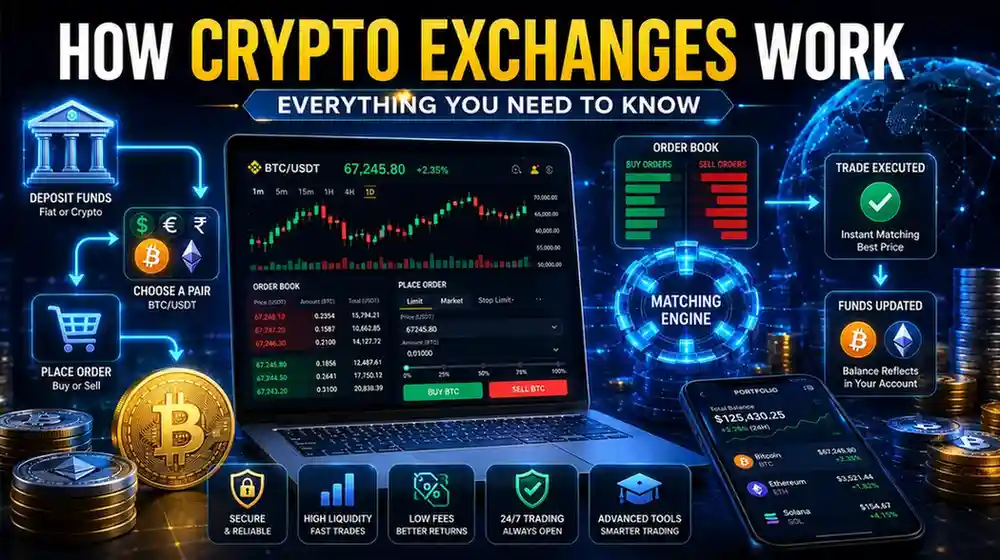
At its core, a cryptocurrency exchange functions as a marketplace that matches buyers with sellers.
Here’s a simplified step-by-step process.
Step 1: Create an Account
Users sign up by providing:
- Email address
- Password
- Identity verification (KYC) on most centralized exchanges
- Two-factor authentication (recommended)
Step 2: Deposit Funds
Most exchanges allow deposits using:
- Bank transfer
- Debit card
- Credit card
- UPI (in supported regions)
- Existing cryptocurrency
Once the deposit is complete, users receive a balance in their exchange account.
Step 3: Choose a Cryptocurrency
The user selects a cryptocurrency they want to purchase.
For example:
- Bitcoin
- Ethereum
- Solana
- XRP
- Cardano
- Avalanche
The exchange displays:
- Current market price
- 24-hour trading volume
- Price history
- Order book
- Market trends
Step 4: Place an Order
Users can choose different order types.
Market Order
Buys or sells immediately at the best available market price.
Best for beginners.
Limit Order
Allows users to specify the exact price at which they want to buy or sell.
The trade only executes when the market reaches that price.
Stop Order
Automatically triggers a trade once a certain price level is reached.
Often used to manage risk.
Step 5: Order Matching
The exchange’s matching engine compares buy and sell orders.
When two compatible orders match:
- The transaction is executed
- Ownership changes
- Account balances update instantly
This process often takes only milliseconds on major exchanges.
Step 6: Store or Withdraw Crypto
After purchasing cryptocurrency, users have two choices.
Keep Assets on the Exchange
Convenient for active traders but generally less secure for long-term holdings.
Transfer to a Personal Wallet
Many experienced investors prefer hardware or software wallets because they provide greater control over private keys and reduce reliance on third-party platforms.
How Cryptocurrency Exchanges Make Money
Although buying and selling crypto seems simple, exchanges generate revenue through several business models.
1. Trading Fees
This is the primary source of income.
Every completed trade usually incurs a small percentage fee.
Example:
- Buy $500 worth of Bitcoin
- Exchange charges 0.1%
- Trading fee = $0.50
Millions of daily transactions generate significant revenue.
2. Withdrawal Fees
Many exchanges charge users a fee when withdrawing cryptocurrencies to external wallets.
These fees often vary depending on network congestion and the specific blockchain.
3. Listing Fees
New cryptocurrency projects may pay exchanges to list their tokens, increasing visibility and liquidity.
However, reputable exchanges typically conduct due diligence before approving listings.
4. Premium Services
Some exchanges offer subscription-based features such as:
- Advanced analytics
- Lower trading fees
- Professional trading tools
- API access
- Institutional services
5. Staking and Lending Services
Certain exchanges enable users to earn rewards by staking supported cryptocurrencies or participating in lending programs. The exchange may retain a portion of the generated rewards as a service fee.
Types of Cryptocurrency Exchanges
Not all exchanges operate the same way. Understanding the differences can help you choose the platform that best matches your goals and experience level.
1. Centralized Exchanges (CEX)
Centralized exchanges are managed by a company that oversees the platform, processes transactions, and often safeguards users’ assets.
How They Work
Users create accounts, complete identity verification (where required), deposit funds, and trade through the exchange’s interface.
Advantages
- Beginner-friendly interface
- High liquidity
- Faster transactions
- Customer support
- Fiat currency support
- Advanced trading tools
Disadvantages
- Users rely on the exchange to safeguard funds
- Potential target for cyberattacks
- Identity verification is usually required
Examples of well-known centralized exchanges include platforms such as Binance, Coinbase, Kraken, and Bybit.
2. Decentralized Exchanges (DEX)
A decentralized exchange operates without a central authority. Instead, trades occur directly between users through smart contracts on blockchain networks.
Users maintain control of their private keys throughout the trading process.
Advantages
- Greater privacy
- Self-custody of assets
- No central intermediary
- Enhanced censorship resistance
Disadvantages
- More complex for beginners
- Limited customer support
- Higher responsibility for wallet security
- Potential transaction (gas) fees depending on the blockchain
Popular decentralized exchanges include Uniswap, PancakeSwap, and dYdX.
3. Hybrid Exchanges
Hybrid exchanges aim to combine the convenience of centralized platforms with the transparency and user control found in decentralized exchanges.
Their goals include:
- Improved security
- Better liquidity
- Faster execution
- Enhanced user experience
Although promising, hybrid exchanges currently represent a smaller segment of the market compared to centralized and decentralized platforms.
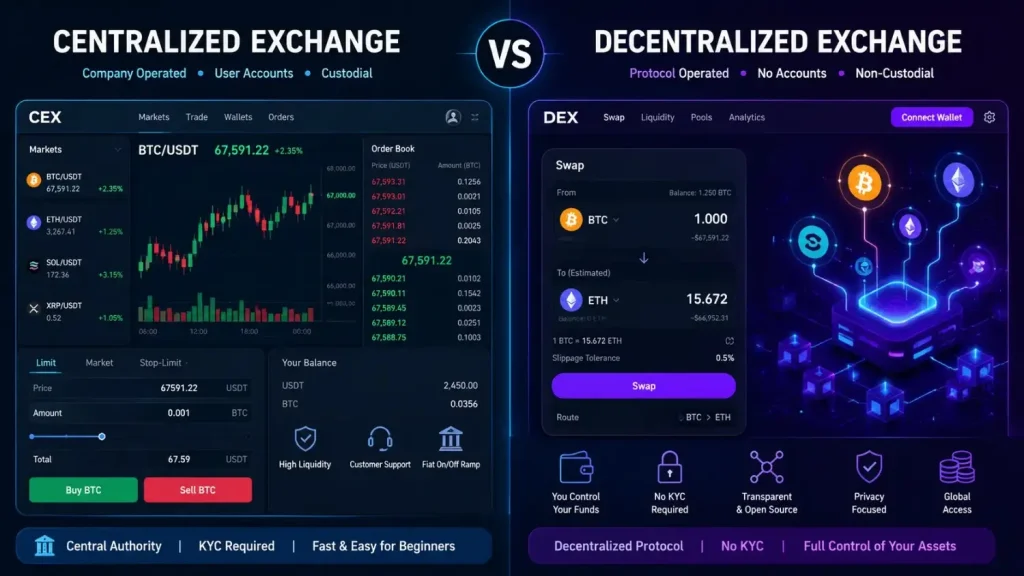
Centralized vs. Decentralized Cryptocurrency Exchanges
Choosing between a Centralized Exchange (CEX) and a Decentralized Exchange (DEX) is one of the first decisions every crypto investor faces. Both serve the same primary purpose—allowing users to trade cryptocurrencies—but they operate in fundamentally different ways.
A centralized exchange prioritizes convenience, customer support, and ease of use, making it ideal for beginners. A decentralized exchange emphasizes user control, privacy, and transparency, making it popular among experienced crypto users.
Comparison Table: CEX vs. DEX
| Feature | Centralized Exchange (CEX) | Decentralized Exchange (DEX) |
|---|---|---|
| Ownership | Operated by a company | Operated through smart contracts |
| Account Required | Yes | Usually No |
| KYC Verification | Usually Required | Usually Not Required |
| Custody | Exchange holds your assets | You control your wallet |
| Trading Speed | Very Fast | Depends on blockchain network |
| Customer Support | Available | Limited or community-based |
| Security Responsibility | Shared with exchange | Entirely on the user |
| Fiat Currency Support | Yes | Rare |
| Best For | Beginners | Advanced users |
| Liquidity | Generally High | Varies by trading pair |
Which One Should Beginners Choose?
If you’re just starting your crypto journey, a Centralized Exchange (CEX) is generally the better option because it offers:
- Simple user interface
- Easy account setup
- Bank deposits
- Educational resources
- Mobile apps
- Customer support
- High liquidity
As you gain experience and become comfortable managing your own wallet, you may decide to explore decentralized exchanges for greater control over your assets.
Key Features of a Cryptocurrency Exchange
Modern cryptocurrency exchanges offer much more than basic buying and selling. Many have evolved into complete financial ecosystems with advanced tools for traders and investors.
1. Spot Trading
Spot trading allows users to buy or sell cryptocurrencies at the current market price.
Example:
- Buy Bitcoin today
- Own the Bitcoin immediately
- Sell whenever you choose
This is the most common trading method for beginners.
2. Margin Trading
Margin trading lets users borrow funds to increase the size of their trades.
For example:
- Deposit $100
- Borrow $400
- Trade with $500
While this can amplify profits, it also increases potential losses. Beginners should approach margin trading with caution.
3. Futures Trading
Futures contracts allow traders to speculate on whether the price of a cryptocurrency will rise or fall without owning the underlying asset.
These products are generally intended for experienced traders due to their complexity and higher risk.
4. Staking
Many exchanges allow users to stake supported cryptocurrencies to help secure blockchain networks and earn rewards.
Benefits of staking include:
- Passive income opportunities
- No active trading required
- Flexible or locked staking options
- Automatic reward distribution on some platforms
5. Crypto Savings Programs
Some exchanges offer interest-bearing accounts where users can deposit certain cryptocurrencies to earn returns.
The available products, rates, and associated risks vary by platform and jurisdiction.
6. NFT Marketplace
Certain exchanges integrate NFT marketplaces where users can:
- Buy NFTs
- Sell NFTs
- Mint NFTs
- Explore digital collectibles
7. Mobile Trading Apps
Most major exchanges provide mobile applications that let users:
- Trade anywhere
- Monitor prices
- Receive price alerts
- Manage portfolios
- Transfer crypto
- Complete identity verification
Understanding Trading Pairs
A trading pair represents the two assets being exchanged.
Examples include:
| Trading Pair | Meaning |
|---|---|
| BTC/USDT | Buy Bitcoin using Tether |
| ETH/BTC | Buy Ethereum using Bitcoin |
| SOL/USDT | Buy Solana using USDT |
| XRP/USDT | Buy XRP using USDT |
If Bitcoin is priced at $120,000 and you purchase one BTC using USDT, you’re trading the BTC/USDT pair.
What Is Liquidity?
Liquidity measures how easily an asset can be bought or sold without significantly affecting its market price.
High Liquidity
- Faster order execution
- Smaller price differences (tighter spreads)
- More buyers and sellers
- Better trading experience
Low Liquidity
- Slower transactions
- Larger price swings
- Higher slippage
- Fewer available buyers and sellers
Popular cryptocurrencies such as Bitcoin and Ethereum generally have higher liquidity than many smaller altcoins.
Types of Cryptocurrency Exchange Fees
Before opening an account, it’s important to understand the fees that exchanges may charge.
Trading Fees
A percentage charged each time you buy or sell cryptocurrency.
Typical range:
- 0.05%–0.5% per trade (varies by platform and trading volume)
Deposit Fees
Some exchanges charge fees when adding funds via:
- Credit cards
- Debit cards
- Third-party payment providers
Bank transfers may be free or lower cost on some platforms.
Withdrawal Fees
When moving crypto from an exchange to your personal wallet, you’ll usually pay a withdrawal fee.
The fee depends on:
- The cryptocurrency
- Network conditions
- The exchange’s fee structure
Spread
Some beginner-friendly platforms build their fee into the difference between the buying and selling price (the spread) rather than displaying a separate trading fee.
Always review the total transaction cost before confirming a trade.
Essential Security Features Every Exchange Should Have
Security should be one of your top priorities when choosing a cryptocurrency exchange.
Look for the following protections.
Two-Factor Authentication (2FA)
Two-factor authentication requires a second verification step, such as a code from an authenticator app, before account access is granted.
This adds an important layer of protection beyond your password.
Cold Wallet Storage
Reputable exchanges often store a significant portion of customer funds in cold wallets, which remain offline and are less vulnerable to online attacks.
Encryption
Sensitive information should be encrypted during transmission and storage to help protect user data.
Withdrawal Whitelisting
Some exchanges allow you to create a list of approved wallet addresses.
If an attacker gains access to your account, they cannot withdraw funds to an unapproved address.
Anti-Phishing Codes
Many platforms let users set a personal anti-phishing code that appears in legitimate emails from the exchange, helping distinguish real messages from fraudulent ones.
Proof of Reserves
Some exchanges publish proof-of-reserves reports to demonstrate that they hold sufficient assets to cover customer balances.
While useful, users should understand the methodology and limitations of these reports.
How to Choose the Best Cryptocurrency Exchange
With hundreds of exchanges available, comparing platforms carefully can help you avoid unnecessary risks.
1. Security Reputation
Research the exchange’s security history.
Consider:
- History of security incidents
- Security practices
- Transparency
- Independent audits (where available)
2. Regulatory Compliance
Check whether the exchange complies with the regulations applicable in the countries where it operates. Regulatory status can affect available services and consumer protections.
3. Supported Cryptocurrencies
Some exchanges list hundreds of cryptocurrencies, while others focus on a smaller selection of major coins.
Choose a platform that supports the assets you intend to trade.
4. Trading Fees
Compare:
- Trading fees
- Deposit fees
- Withdrawal fees
- Spreads
- Premium service costs
Lower fees can make a meaningful difference over time, especially for frequent traders.
5. User Experience
A clean interface can make learning much easier.
Look for:
- Intuitive navigation
- Educational resources
- Responsive mobile app
- Reliable customer support
6. Liquidity
Higher liquidity generally means:
- Faster trades
- Better pricing
- Lower slippage
This is particularly important for active traders.
7. Customer Support
Reliable support can be invaluable if you encounter account, verification, or transaction issues.
Check whether the exchange offers:
- Live chat
- Email support
- Help center
- Community forums
Common Mistakes Beginners Should Avoid
Many first-time crypto investors make avoidable mistakes. Being aware of them can help you protect your funds and make better decisions.
Leaving Large Amounts on an Exchange
Exchanges are convenient for trading, but many long-term investors prefer moving significant holdings to a personal wallet where they control the private keys.
Ignoring Security Settings
Failing to enable 2FA, using weak passwords, or reusing passwords across websites can leave your account vulnerable.
Investing Without Research
Buying cryptocurrencies solely because they’re trending on social media can lead to poor investment decisions. Always research the project’s fundamentals, use case, and risks.
Falling for Scams
Be cautious of:
- Fake exchange websites
- Phishing emails
- Fraudulent giveaways
- “Guaranteed profit” schemes
- Impersonation accounts on social media
If an offer sounds too good to be true, it probably is.
Trading Based on Emotions
Fear and excitement often lead to impulsive decisions.
Developing a plan, setting realistic goals, and managing risk can help you avoid emotional trading.

Benefits of Using a Cryptocurrency Exchange
Cryptocurrency exchanges have made digital assets accessible to millions of people around the world. Whether you’re buying your first Bitcoin or actively trading multiple cryptocurrencies, these platforms provide the tools needed to participate in the crypto economy.
1. Easy Access to the Crypto Market
One of the biggest advantages of cryptocurrency exchanges is accessibility.
Instead of searching for someone willing to sell cryptocurrency directly, users can simply create an account, deposit funds, and purchase digital assets within minutes.
This convenience has played a major role in the global adoption of cryptocurrencies.
2. Hundreds of Cryptocurrency Choices
Most leading exchanges support a wide range of digital assets.
Depending on the platform, users may be able to trade:
- Bitcoin (BTC)
- Ethereum (ETH)
- Solana (SOL)
- XRP
- Cardano (ADA)
- Avalanche (AVAX)
- Chainlink (LINK)
- Thousands of other cryptocurrencies
Having access to multiple assets allows investors to diversify their portfolios instead of relying on a single cryptocurrency.
3. Real-Time Market Data
Cryptocurrency exchanges provide valuable information such as:
- Live prices
- Trading volume
- Market capitalization
- Price charts
- Order books
- Technical indicators
- Portfolio performance
This data helps users make more informed trading and investment decisions.
4. Fast Transactions
Unlike traditional financial systems that may take days to settle certain transfers, crypto exchanges can execute trades within seconds.
Deposits and withdrawals still depend on the payment method and blockchain network, but order execution on liquid markets is generally very fast.
5. Advanced Trading Tools
Many exchanges offer professional-grade tools including:
- Stop-loss orders
- Take-profit orders
- Limit orders
- Market orders
- Price alerts
- Portfolio analytics
- API access for automated trading
Beginners can start with basic features while experienced traders can explore advanced functionality.
6. Educational Resources
Many leading exchanges now provide:
- Beginner tutorials
- Crypto academies
- Market research
- Webinars
- Learning rewards
- Investment guides
These resources help new investors understand blockchain technology, cryptocurrency markets, and risk management.
7. Passive Income Opportunities
Some exchanges allow users to earn rewards through:
- Staking
- Flexible savings products
- Locked earning programs
- Validator participation (where supported)
While these features can generate additional returns, users should understand the associated risks and terms before participating.
Challenges and Risks of Cryptocurrency Exchanges
Despite their advantages, cryptocurrency exchanges are not without risks. Every investor should understand these challenges before investing.
1. Cybersecurity Threats
Because exchanges hold valuable digital assets, they remain attractive targets for hackers.
Although security standards have improved significantly over the years, no platform can guarantee absolute protection.
Users should always enable:
- Two-factor authentication (2FA)
- Strong, unique passwords
- Withdrawal whitelist (if available)
- Anti-phishing codes
2. Market Volatility
Cryptocurrency prices can change dramatically within minutes.
For example:
- Bitcoin may rise by 10% in a day.
- A smaller altcoin could lose 30% in a matter of hours.
Volatility creates opportunities but also increases investment risk.
3. Regulatory Changes
Governments around the world continue to develop cryptocurrency regulations.
New rules may affect:
- Available trading pairs
- Identity verification requirements
- Tax reporting
- Exchange operations
- Access to certain products
Staying informed about regulations in your country is essential.
4. Scam Exchanges
Unfortunately, not every platform is trustworthy.
Warning signs include:
- Unrealistic guaranteed returns
- Anonymous operators
- Poor security practices
- Fake reviews
- No regulatory information
- Pressure to deposit funds quickly
Always research an exchange before creating an account or depositing money.
5. Custody Risks
If you keep your cryptocurrency on an exchange, the platform controls the private keys.
This means you’re relying on the exchange’s security and operational practices.
Many experienced investors follow the popular principle:
“Not your keys, not your coins.”
For long-term holdings, many users prefer transferring assets to a personal hardware wallet or other self-custody solution.
Best Practices for Beginners
If you’re new to cryptocurrency, following these practices can help you reduce risk and build confidence.
Start Small
Avoid investing more money than you can afford to lose.
Beginning with a modest amount allows you to learn how exchanges work without taking excessive financial risk.
Use Trusted Exchanges
Choose platforms with:
- Strong security records
- Transparent fee structures
- Good customer support
- High trading volume
- Positive reputation
Enable All Security Features
Before making your first trade:
- Enable 2FA
- Use a password manager
- Verify email authenticity
- Review withdrawal settings
Learn Before Trading
Take time to understand:
- Market orders
- Limit orders
- Blockchain basics
- Wallet security
- Risk management
Knowledge is one of the best tools for avoiding common mistakes.
Diversify Your Portfolio
Rather than investing everything in a single cryptocurrency, many investors spread their investments across multiple assets to reduce concentration risk.
Diversification does not eliminate risk but may help manage it.
Future of Cryptocurrency Exchanges
The cryptocurrency exchange industry continues to evolve rapidly as blockchain technology matures.
Several trends are expected to shape the future of crypto trading.
Greater Regulation
Many countries are introducing clearer regulatory frameworks.
While compliance requirements may increase, clearer regulations could also improve consumer confidence and encourage broader institutional participation.
Better Security
Future exchanges are likely to adopt even stronger security measures, including:
- Multi-party computation (MPC)
- Enhanced biometric authentication
- AI-powered fraud detection
- Improved cold storage solutions
- Continuous risk monitoring
More Institutional Adoption
Banks, investment firms, and publicly traded companies are increasingly exploring digital assets.
As institutional participation grows, exchanges may expand services tailored to professional investors.
AI-Powered Trading Tools
Artificial intelligence is becoming an important part of cryptocurrency trading.
Modern exchanges are beginning to introduce features such as:
- Smart market insights
- Automated risk analysis
- Personalized portfolio recommendations
- AI-assisted customer support
These tools can help users analyze market data more efficiently, though they should not replace independent research.
Improved User Experience
Future platforms are expected to become:
- Easier to use
- Faster
- More secure
- More transparent
This could make cryptocurrency investing more accessible to mainstream users worldwide.
Final Thoughts
A cryptocurrency exchange is much more than a place to buy and sell digital assets—it’s the gateway to the broader world of blockchain technology and decentralized finance.
For beginners, understanding how exchanges work is an essential first step. From learning the difference between centralized and decentralized exchanges to understanding trading fees, security features, and common risks, building a strong foundation can help you make more informed decisions.
Remember that cryptocurrency investing involves risk. Markets can be highly volatile, and no exchange or investment strategy can guarantee profits. Always conduct your own research, prioritize security, and invest responsibly.
As the crypto industry continues to evolve, exchanges are expected to become more secure, user-friendly, and feature-rich, making it easier than ever for new users to participate in the digital economy.
Key Takeaways
- A cryptocurrency exchange is a platform for buying, selling, and trading digital assets.
- Centralized exchanges are generally more beginner-friendly, while decentralized exchanges provide greater user control.
- Security features such as two-factor authentication and cold storage are essential.
- Understand all applicable fees before trading.
- Research any exchange thoroughly before depositing funds.
- Never invest more than you can afford to lose.
- Consider using a personal wallet for long-term storage of significant holdings.
Conclusion
Whether you’re planning to buy your first Bitcoin or simply exploring blockchain technology, understanding cryptocurrency exchanges is one of the most valuable skills you can develop as a beginner.
Take your time, continue learning, and focus on building good security habits from the start. The cryptocurrency market offers exciting opportunities, but informed decision-making is the key to navigating it responsibly.
Ready to start your crypto journey?
Share this guide with friends who are new to cryptocurrency, leave a comment with your questions, and subscribe to ThePulseTime.site for more beginner-friendly crypto guides, blockchain insights, market analysis, and the latest industry news.
Frequently Asked Questions (FAQs)
1. What is a cryptocurrency exchange?
A cryptocurrency exchange is an online platform where users can buy, sell, and trade digital currencies like Bitcoin, Ethereum, and many other cryptocurrencies.
2. Is a cryptocurrency exchange safe?
Reputable exchanges implement strong security measures such as encryption, cold storage, and two-factor authentication. However, users should also follow good security practices and research the platform before investing.
3. What is the difference between a centralized and decentralized exchange?
A centralized exchange is operated by a company and typically offers customer support and easier onboarding. A decentralized exchange uses blockchain-based smart contracts, allowing users to trade directly from their own wallets.
4. Do I need a wallet to use a cryptocurrency exchange?
Not always. Many exchanges provide built-in custodial wallets. However, for long-term storage, many investors prefer using a personal hardware or software wallet.
5. What fees do cryptocurrency exchanges charge?
Common fees include trading fees, deposit fees, withdrawal fees, and, in some cases, spreads between buying and selling prices. Fee structures vary by platform.
6. Can beginners use cryptocurrency exchanges?
Yes. Many centralized exchanges are designed specifically for beginners, offering intuitive interfaces, educational resources, and simple purchasing options.
7. Which cryptocurrency exchange is best for beginners?
The best exchange depends on your location, security preferences, supported payment methods, fees, and the cryptocurrencies you wish to trade. Always compare features and conduct independent research before choosing a platform.
8. Can I lose money on a cryptocurrency exchange?
Yes. Cryptocurrency prices are highly volatile, and investing carries financial risk. There is also platform risk if you choose an unreliable exchange. Never invest more than you can afford to lose.



Leave a Reply