

If you’ve ever wished your AI assistant could stop waiting for instructions and just get things done, Claude Routines might be the upgrade you’ve been dreaming about. Anthropic’s new routines feature lets you automate workflows with Claude routines — meaning Claude can now run scheduled, multi-step tasks on your behalf, from morning market briefings to weekly portfolio reports. It’s less “chatbot” and more “always-on digital coworker.”
In this guide, you’ll learn what Claude Routines actually are, how they work under the hood, real workflows you can steal today (including crypto-focused ones), the benefits, the risks, and where this is all heading. Whether you’re a beginner exploring AI or a trader hunting for an edge, this is your practical playbook.
What you’ll learn in this article:
- What Claude Routines are and how they differ from regular prompts
- Step-by-step setup for your first automated workflow
- 7 real-world routine ideas (crypto, research, content, ops)
- Benefits, risks, and honest limitations
- Expert perspectives and the future outlook for agentic AI
If you’re new to AI tooling, you may also enjoy our beginner-friendly breakdown on how AI is reshaping Web3 in 2025 before diving deeper.

What Are Claude Routines, Really?
Think of a routine as a saved recipe that Claude follows on a schedule — or on a trigger — without you re-typing the prompt every time. Instead of asking Claude the same question every Monday morning (“Summarize crypto news from the weekend”), you define it once, set the cadence, and Claude executes.
Routines combine three ingredients:
- A trigger — time-based (e.g., 8 AM daily) or event-based (e.g., new email, new file).
- A workflow — the sequence of steps Claude will perform.
- Tools & context — the data sources, APIs, or connectors Claude can access (web search, Gmail, Google Drive, Notion, etc.).
This shifts Claude from a reactive chatbot into a proactive agent — a distinction Anthropic’s research team has emphasized in their public writing on agentic systems. Anthropic’s engineering blog on building effective agents{target=”_blank” rel=”noopener noreferrer”} is worth bookmarking if you want the deeper technical view.
How Claude Routines Actually Work
Under the hood, a routine is essentially a persistent agent loop. Claude receives your instructions, plans the steps, calls tools when needed, checks its own output, and delivers the result to your chosen destination — Slack, email, a doc, or a dashboard.
Here’s the simplified flow:
| Stage | What Happens | Who Controls It |
|---|---|---|
| Trigger | Time or event fires | You (schedule) |
| Plan | Claude breaks task into steps | Claude |
| Execute | Tools called, data fetched | Claude + connectors |
| Review | Self-check for errors | Claude |
| Deliver | Output sent to you | You (destination) |
The magic isn’t in any single step — it’s that you don’t have to babysit it.
How to Set Up Your First Claude Routine (Step-by-Step)
You don’t need to be a developer. Here’s the beginner path:
- Open Claude and navigate to the Routines (or Automations) panel in your workspace.
- Click “New Routine” and give it a clear name like “Daily Crypto Brief.”
- Write your instructions in plain English — treat Claude like a smart intern.
- Connect tools you’ll need (web search, Gmail, Drive, Notion, etc.).
- Set the schedule — daily, weekly, or event-based.
- Choose the output destination — email, message, doc, or dashboard.
- Test once, tweak, and let it run.
Pro tip: Start with one routine. Nail it. Then scale.
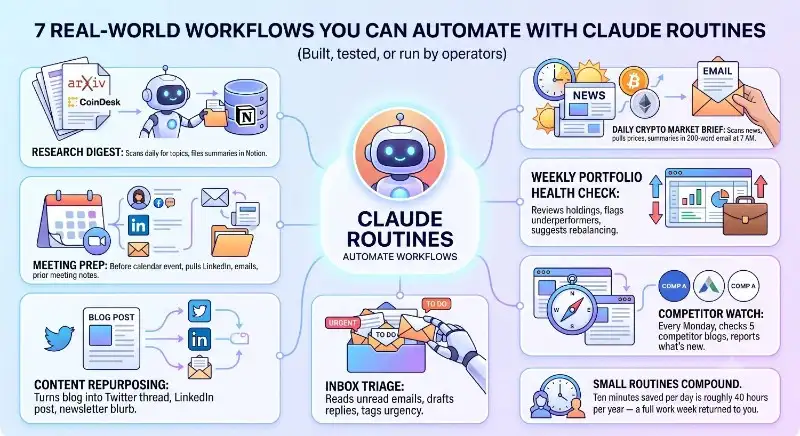
7 Real-World You Can Automate Workflows With Claude Routines
Here’s where it gets fun. These are workflows I’ve either built, tested, or seen operators run:
- Daily Crypto Market Brief — Claude scans overnight news, pulls BTC/ETH prices, summarizes into a 200-word email at 7 AM.
- Weekly Portfolio Health Check — Claude reviews your holdings sheet, flags underperformers, suggests rebalancing questions.
- Competitor Watch — Every Monday, Claude checks 5 competitor blogs and reports what’s new.
- Inbox Triage — Claude reads unread emails, drafts replies, tags urgency.
- Content Repurposing — Turn each new blog post into a Twitter thread, LinkedIn post, and newsletter blurb automatically.
- Meeting Prep — Before each calendar event, Claude pulls the attendee’s LinkedIn, recent emails, and prior meeting notes.
- Research Digest — Claude scans arXiv or CoinDesk daily for topics you care about and files summaries in Notion.
Small routines compound. Ten minutes saved per day is roughly 40 hours per year — a full work week returned to you.
✦ Benefits of Automating Workflows With Claude Routines
The upside is more than just “saving time.” It’s a shift in how you operate.
- Consistency — Claude never forgets, never has a bad Monday.
- Speed — Tasks that took 30 minutes now take 30 seconds of review.
- Focus — You reclaim mental bandwidth for creative, high-value work.
- Scalability — One person can now do what previously required a small team.
- Compounding intelligence — Routines get better as you refine prompts and add memory.
For crypto traders specifically, having an always-on research assistant is a meaningful edge. Markets don’t sleep, and neither does a well-configured routine. If you’re just getting started with digital assets, our guide on how to start investing in crypto safely in 2025 pairs nicely with a Claude-powered research routine.
✦ Challenges and Risks You Should Know About
Let’s keep it honest — this isn’t magic, and it’s not risk-free.
1. Hallucinations still happen. Claude can confidently produce wrong data, especially with fast-moving prices. Always verify financial numbers with a primary source like CoinDesk{target=”_blank” rel=”noopener noreferrer”} before acting.
2. Prompt drift. A routine that worked in January may underperform in July as the web changes. Review your routines monthly.
3. Data privacy. Connecting Gmail, Drive, or trading APIs means Claude has access to sensitive information. Use least-privilege connectors.
4. Over-automation. Not everything should be automated. Judgment-heavy tasks (final trade decisions, hiring calls, legal replies) still belong to humans.
5. Cost creep. Frequent routines that call web search and long-context models can rack up API bills. Monitor usage.
6. Silent failures. If a routine breaks quietly at 6 AM, you may not notice for days. Add error notifications to your setup.
Expert Insights: What Practitioners Are Saying
Anthropic’s CEO Dario Amodei has repeatedly framed 2025–2026 as the era where AI moves from “answering questions” to “completing tasks.” Independent AI researcher Simon Willison has echoed this on his blog, noting that scheduled agents are “the most underrated productivity leap of the year.”
On the crypto side, analysts increasingly describe AI agents as a force multiplier for retail traders — the same information asymmetry that once favored hedge funds is narrowing. That doesn’t mean AI picks winners; it means the research floor is rising for everyone.
A Mini Case Study: The 20-Minute Morning
A freelance crypto writer I spoke with replaced a 90-minute morning routine (scanning Twitter, CoinDesk, CoinTelegraph, on-chain dashboards) with three Claude routines running at 6:45 AM:
- Routine A: Overnight price + volume snapshot
- Routine B: Top 10 crypto news headlines with 1-line summaries
- Routine C: On-chain whale activity from a public API
By 7:05 AM she has a single Notion page with everything. Her writing output roughly doubled in a month, and she reports lower morning stress. That’s the real-world payoff.
Beginner Tips to Get More From Claude Routines
- Write prompts like briefs, not commands. Include the why, the audience, and the format.
- Use examples. Show Claude one great output — it will imitate the style.
- Add “if unsure, say so.” This dramatically reduces hallucinations.
- Keep outputs short by default. Long reports rarely get read.
- Version your routines. Duplicate before editing, so you can roll back.
✦ Future Outlook: Where Claude Routines Are Heading
Routines are the on-ramp to something bigger — persistent, memory-rich AI agents that operate across your digital life. Expect three shifts in the next 12–24 months:
- Deeper tool ecosystems — routines that trade, book, buy, and negotiate, not just summarize.
- Cross-agent collaboration — your Claude routine talking to your calendar’s AI and your accountant’s AI.
- Regulation catching up — expect clearer rules on autonomous financial actions, especially in the U.S. and EU.
For crypto specifically, imagine routines that monitor your wallet, alert you to smart contract risks, and auto-draft transactions for human approval. That world isn’t five years away — it’s arguably twelve months away.
Conclusion: Small Routines, Big Compounding
You don’t need a moonshot to benefit from Claude Routines. Start with one boring workflow you hate doing — an inbox summary, a Monday briefing, a research digest — and let Claude take it. The compounding is where the magic lives.
If this guide helped you rethink your workflow, share it with a friend who’s still copy-pasting prompts every morning, drop a comment with the first routine you plan to build, and subscribe to the ThePulseTime newsletter for weekly AI + crypto playbooks.
One question to leave you with: If Claude handled the first 30 minutes of your workday tomorrow, what would you actually do with that time?
FAQs
1. What does it mean to automate workflows with Claude routines? It means setting up saved, scheduled instructions that Claude executes automatically — like a recurring task list an AI runs for you without repeated prompting.
2. Do I need coding skills to use Claude Routines? No. Routines are configured in plain English through Claude’s interface. Coding only helps for advanced API-based triggers.
3. Is Claude Routines free? Basic use is included in Claude’s paid plans. Heavy usage — especially with web search and tool calls — may increase costs.
4. Can Claude Routines trade crypto for me? Not directly and not recommended without human approval. Routines can research, alert, and draft — but autonomous trading raises serious risk and regulatory concerns.
5. How accurate is Claude when running routines? Very good for summarization and research, weaker on fast-changing numbers. Always verify prices, stats, and legal claims with primary sources.
6. Can I connect Claude Routines to Gmail, Notion, or Slack? Yes, through official connectors and integrations, depending on your plan and workspace setup.
7. How is this different from Zapier or Make? Zapier moves data between apps using fixed rules. Claude Routines add reasoning — Claude decides what to do based on context, not just triggers.
8. What’s the best first routine for a beginner? A daily 200-word news brief on a topic you care about. It’s low-risk, high-value, and teaches you how to refine prompts quickly.

Leave a Reply