
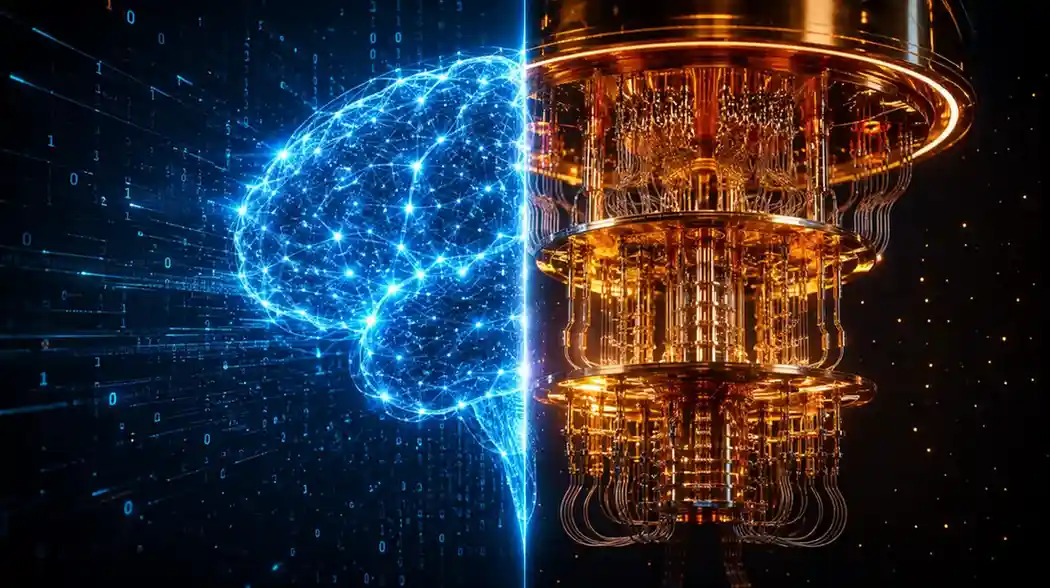
If you’ve been paying any attention to the tech world lately, you’ve probably heard two massive buzzwords dominating the headlines: Artificial Intelligence and Quantum Computing. Both are often hailed as the “next big thing” that will change our lives forever.
But if you are feeling a little confused about the quantum computing vs AI difference, you are definitely not alone. Are they the same thing? Are they competing technologies? Or are they teaming up to create something straight out of a sci-fi movie?
In this guide, we are going to break down these complex technologies into plain, bite-sized English. By the end of this article, you’ll know exactly how they differ, where they overlap, and what this means for the future of technology, crypto, and our daily lives.
What You Will Learn in This Article:
- The core definitions of AI and Quantum Computing in simple terms.
- A clear breakdown of the quantum computing vs AI difference.
- How these two powerhouse technologies are starting to merge.
- The benefits, real-world challenges, and future outlook of a Quantum-AI world.
What is Artificial Intelligence (AI)?
Let’s start with the one we interact with every day. Artificial Intelligence (AI) is all about teaching computers to think, learn, and make decisions like humans. When you ask ChatGPT a question, use face unlock on your phone, or let Netflix recommend your next binge-watch, you are using AI.
At its core, AI relies on massive amounts of data. It uses complex algorithms (specifically Machine Learning and Deep Learning) to recognize patterns. It doesn’t “know” things the way we do; it simply calculates the most likely correct answer based on the millions of examples it has been fed.
What is Quantum Computing?
Now, let’s look at the other side of the ring. Quantum computing is an entirely new way of processing information.
Your laptop, your smartphone, and even the supercomputers running today’s AI use bits. A bit is like a light switch—it can only be a 1 (on) or a 0 (off).
Quantum computers use qubits (quantum bits). Thanks to mind-bending physics concepts like superposition and entanglement, a qubit can be a 1, a 0, or both at the exact same time. Imagine trying to escape a maze. A regular computer tries every single path one by one until it finds the exit. A quantum computer tries every single path simultaneously. It is unimaginably fast for certain types of complex mathematical problems.
Quantum Computing vs AI Difference: The Core Breakdown
So, what is the actual quantum computing vs AI difference?
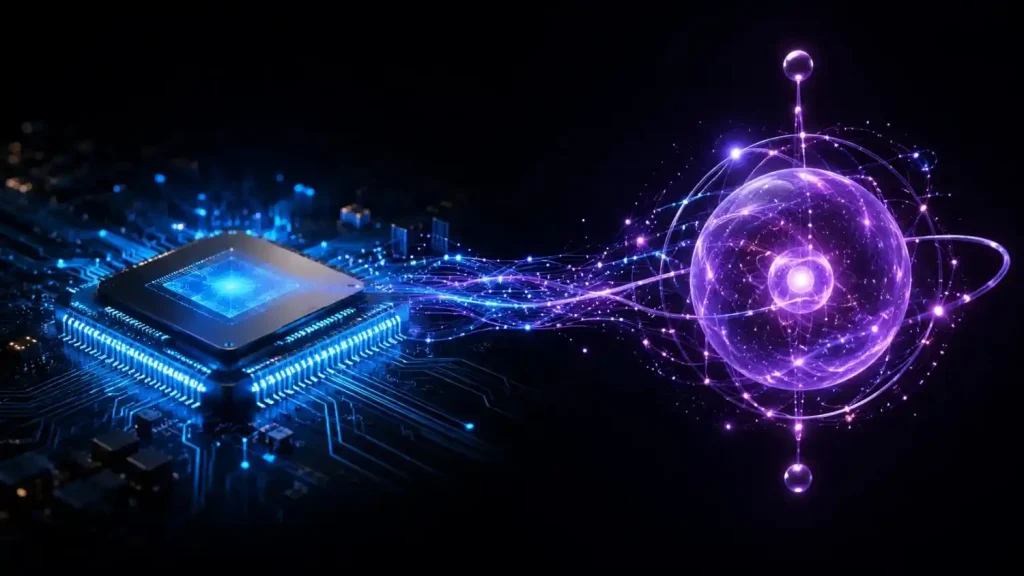
The easiest way to think about it is this: AI is the software (the brain), and Quantum Computing is the hardware (the muscle). AI is a method of analyzing data and making smart predictions. Quantum computing is a revolutionary machine architecture designed to process complex calculations at speeds classical computers could never reach.
Here is a quick comparison table to make it crystal clear:
| Feature | Artificial Intelligence (AI) | Quantum Computing |
| Primary Goal | To simulate human intelligence, learn, and predict. | To solve highly complex mathematical problems instantly. |
| How it Works | Uses algorithms and data to find patterns. | Uses quantum physics (qubits) to run parallel calculations. |
| Current Status | Widely available and used daily by the public. | In experimental stages; mostly used by massive tech labs. |
| Analogy | The incredibly smart student who memorized the textbook. | The calculator that can solve a thousand equations at once. |
✦ Benefits: When Quantum Meets AI
While the quantum computing vs AI difference is stark, the real magic happens when they team up. This concept is known as Quantum AI.
Current AI models take months to train and require massive amounts of electricity. If we run AI algorithms on quantum computers, the benefits are staggering:
- Lightning-Fast Medical Cures: AI could simulate millions of molecular structures to find cures for diseases in hours instead of decades.
- Flawless Financial Modeling: Quantum AI could predict stock market crashes or optimize massive investment portfolios in real-time.
- Smarter Climate Solutions: We could process complex environmental data to discover new, hyper-efficient battery materials to combat climate change.
✦ Challenges / Risks: The Dark Side of the Tech
It’s not all sunshine and futuristic utopias. The road to a Quantum-AI future is packed with massive hurdles.
First, quantum computers are incredibly fragile. They require temperatures colder than deep space to function, and any slight vibration can cause them to lose their data (a problem called “decoherence”).
Second, there is a massive security risk. Experts at institutions like IBM warn that future quantum computers could easily crack the encryption that protects our banking systems, military secrets, and digital assets. If a rogue entity pairs AI’s hacking capabilities with quantum speed, traditional cybersecurity will be instantly obsolete.
✦ Future Outlook: What’s Next?
We are still in the early days. Right now, classical computers are more than enough to handle today’s AI models. However, tech giants like Google, IBM, and Microsoft are pouring billions into making quantum computers stable and commercially viable.
By the 2030s, we will likely see “Quantum-as-a-Service,” where companies rent quantum computing power through the cloud to train their massive AI models. The quantum computing vs AI difference will blur as they become two halves of the ultimate technological engine.
Conclusion
Understanding the quantum computing vs AI difference boils down to separating the “how” from the “what.” AI is the brilliant software learning from our world, while quantum computing is the next-generation hardware that will eventually give that software unprecedented power.
We are standing on the edge of a computing revolution that will reshape everything from medicine to the global economy.
What do you think? Are you excited about the possibilities of Quantum AI, or does the security risk make you nervous? Let us know your thoughts in the comments below, and don’t forget to subscribe to our newsletter for more easy-to-understand tech and crypto insights!
FAQs
1. What is the main difference between AI and quantum computing?
AI is a type of software designed to learn from data and make intelligent decisions. Quantum computing is a type of hardware that uses the principles of quantum mechanics to process complex calculations at unimaginable speeds. AI is the brain; quantum is the muscle.
2. Can quantum computers create better AI?
Yes. Quantum computers can process vast amounts of data simultaneously. This means they could train AI models exponentially faster and handle far more complex variables than traditional computers, leading to much smarter Artificial Intelligence.
3. Will quantum computers replace regular computers?
No, probably not. Quantum computers are designed for very specific, highly complex mathematical problems. For everyday tasks like browsing the web, sending emails, or playing standard video games, classical computers (like your laptop) will remain the standard.
4. Are quantum computers dangerous to crypto?
Potentially. Because quantum computers are incredibly fast at solving complex math, they theoretically have the power to break the cryptographic codes that secure Bitcoin and other cryptocurrencies. However, blockchain developers are already working on “quantum-resistant” encryption to protect digital assets.
5. How soon will quantum AI be available?
While basic quantum computers exist today in research labs, they are prone to errors. Most experts predict it will take another 5 to 15 years before we see stable, commercially viable Quantum AI applications impacting everyday industries.
6. Is AI needed to build quantum computers?
It helps! Researchers are currently using AI to design better quantum chips and to figure out ways to stabilize qubits, reducing the errors that plague current quantum machines.
7. What is a qubit in simple terms?
A qubit (quantum bit) is the basic unit of information in a quantum computer. While a regular computer bit can only be a 1 or a 0, a qubit can exist as a 1, a 0, or both simultaneously, allowing the computer to multitask on a massive scale.
8. Should I invest in quantum computing or AI?
Both represent massive growth sectors. AI is currently booming and offers many immediate investment opportunities. Quantum computing is more of a long-term, high-risk, high-reward play, as the technology is still in its experimental phase. Always do your own research before investing.




Leave a Reply