

The cryptocurrency market has matured significantly over the past few years, but it still remains one of the most exciting—and risky—investment opportunities available today. If you’ve been wondering how to start investing in crypto safely in 2026, you’re not alone. Millions of beginners are entering the digital asset market every year, attracted by the potential for long-term growth, decentralized finance (DeFi), and blockchain innovation.
However, investing without understanding the basics can quickly lead to costly mistakes. From choosing the wrong exchange to falling victim to phishing scams or investing in hype-driven meme coins, beginners face many challenges.
The good news? You don’t need to be a technology expert or financial professional to start investing safely.
This comprehensive beginner’s guide will walk you through every essential step—from understanding cryptocurrency and selecting a trusted exchange to protecting your assets and building a long-term investment strategy.
What You’ll Learn
By the end of this guide, you’ll understand:
- What cryptocurrency really is
- Why people invest in crypto
- How much money beginners should start with
- How to choose a safe crypto exchange
- How crypto wallets work
- Risk management strategies
- Common beginner mistakes
- Security tips that protect your investments
- Long-term investment strategies for 2026

Why Crypto Investing Is Still Growing in 2026
Despite multiple market cycles, cryptocurrency continues attracting investors worldwide because blockchain technology is expanding into nearly every industry.
Some of the biggest growth areas include:
- Decentralized Finance (DeFi)
- Tokenized Real-World Assets (RWAs)
- Artificial Intelligence + Blockchain
- Stablecoins
- Gaming (GameFi)
- NFTs
- Cross-border payments
- Institutional Bitcoin adoption
Governments are also becoming more crypto-friendly by creating clearer regulations, making digital assets more accessible for everyday investors.
What Is Cryptocurrency?
Cryptocurrency is digital money secured by cryptography and powered by blockchain technology.
Unlike traditional money, cryptocurrencies operate without central banks.
Popular cryptocurrencies include:
| Cryptocurrency | Purpose |
|---|---|
| Bitcoin (BTC) | Digital Store of Value |
| Ethereum (ETH) | Smart Contracts & DeFi |
| Solana (SOL) | Fast Blockchain Applications |
| BNB | Exchange & Blockchain Ecosystem |
| XRP | International Payments |
Each cryptocurrency serves a different purpose, making research essential before investing.
Why Do People Invest in Crypto?
People invest in cryptocurrency for several reasons.
1. Long-Term Growth
Bitcoin has delivered extraordinary returns over the last decade, outperforming many traditional assets.
Although past performance doesn’t guarantee future returns, many investors see crypto as a long-term opportunity.
2. Portfolio Diversification
Adding cryptocurrency to a diversified investment portfolio may reduce dependence on traditional markets.
Many investors combine:
- Stocks
- Mutual Funds
- Gold
- Bonds
- Cryptocurrency
to balance risk.
3. Inflation Protection
Some investors consider Bitcoin “digital gold” because its supply is limited to 21 million coins.
This scarcity has made Bitcoin attractive during periods of rising inflation.
4. Passive Income
Several cryptocurrencies allow holders to earn rewards through:
- Staking
- Yield Farming
- Lending
- Liquidity Pools
However, these opportunities also involve additional risks.
Is Crypto Safe?
This is the question every beginner asks.
The answer is:
Crypto itself is secure.
But investing becomes risky when people:
- Buy unknown coins
- Ignore security
- Fall for scams
- Store assets carelessly
- Invest emotionally
Most losses happen because of poor decisions—not because blockchain technology failed.
How Much Money Should Beginners Invest?
One of the biggest myths is that you need thousands of dollars.
You don’t.
Many exchanges allow purchases starting from as little as $10–$20 (or the equivalent in local currency).
A good beginner approach is:
- Invest only what you can afford to lose.
- Start with a small amount.
- Learn before increasing your investment.
- Avoid borrowing money to buy crypto.
Step 1: Set Clear Investment Goals
Before purchasing any cryptocurrency, ask yourself:
- Are you investing for 1 year?
- Five years?
- Retirement?
- Passive income?
- Trading profits?
Your goals determine your investment strategy.
For example:
| Goal | Strategy |
|---|---|
| Long-term wealth | Buy and Hold |
| Passive income | Staking |
| Active profits | Trading |
| Diversification | Dollar Cost Averaging |
Step 2: Learn the Major Cryptocurrencies
Beginners should focus on established projects.
Bitcoin (BTC)
The largest cryptocurrency.
Often viewed as digital gold.
Best suited for long-term investors.
Ethereum (ETH)
The leading smart contract platform.
Supports:
- NFTs
- DeFi
- Gaming
- AI applications
Solana (SOL)
Known for:
- Fast transactions
- Low fees
- Growing developer ecosystem
Stablecoins
Examples include:
- USDT
- USDC
Their value remains close to the US Dollar, making them useful for reducing market volatility.
Avoid These Beginner Mistakes
Many first-time investors lose money because they:
❌ Buy coins based on social media hype
❌ Invest without research
❌ Panic during market crashes
❌ Ignore security
❌ Trust influencers blindly
❌ Keep all crypto on exchanges
❌ Chase unrealistic returns
Successful investors stay patient and focus on long-term strategies.
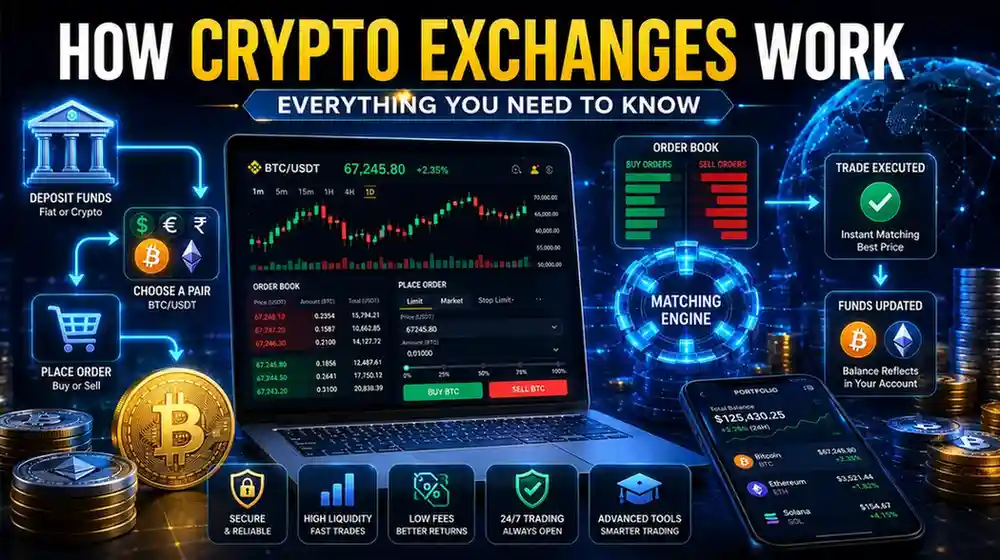
Step 3: Choose a Trusted Crypto Exchange
Your crypto exchange is where you’ll buy your first digital assets.
When selecting an exchange, consider:
- Strong security
- Two-factor authentication
- Good reputation
- High liquidity
- Regulatory compliance
- Low fees
- Easy-to-use interface
Avoid unknown exchanges offering unrealistic rewards or guaranteed profits.
Step 4: Create Your Crypto Exchange Account
Once you’ve selected a reputable cryptocurrency exchange, the next step is creating your account.
Most major exchanges follow a similar registration process.
Here’s how it typically works:
- Visit the official exchange website or download its mobile app.
- Register using your email address or phone number.
- Create a strong, unique password.
- Verify your email and phone number.
- Enable Two-Factor Authentication (2FA) immediately.
- Complete identity verification (KYC).
Never register through links shared on social media or messaging apps. Always double-check the website URL to avoid phishing scams.
Step 5: Complete KYC Verification
Most regulated crypto exchanges require users to complete Know Your Customer (KYC) verification before buying or withdrawing cryptocurrency.
Typically, you’ll need:
- Government-issued ID (Passport, Driving License, Aadhaar, etc.)
- Selfie verification
- Address proof (if required)
Why KYC Matters
Although some people dislike verification, it actually offers several benefits:
- Prevents fraud
- Increases account security
- Unlocks higher transaction limits
- Helps exchanges comply with regulations
Legitimate exchanges prioritize user security and regulatory compliance.
Step 6: Secure Your Account Before Depositing Money
Before adding funds, take a few minutes to strengthen your account security.
Enable These Security Features
✅ Two-Factor Authentication (2FA)
Use an authenticator app instead of SMS whenever possible.
Examples include:
- Google Authenticator
- Microsoft Authenticator
- Authy
✅ Anti-Phishing Code
Some exchanges allow you to create a custom security phrase that appears in official emails.
If an email doesn’t include your code, it’s likely a phishing attempt.
✅ Withdrawal Whitelist
Enable withdrawal address whitelisting so your crypto can only be sent to approved wallet addresses.
✅ Strong Password
Avoid using:
- Birthdates
- Phone numbers
- Simple words
Instead, use a password manager to generate a unique password.
Step 7: Deposit Funds
Most exchanges offer several funding methods.
Common options include:
| Method | Speed | Fees |
|---|---|---|
| Bank Transfer | Medium | Low |
| Debit Card | Instant | Medium |
| Credit Card | Instant | High |
| UPI (where available) | Fast | Low |
| P2P Trading | Fast | Varies |
If you’re investing regularly, bank transfers usually offer lower fees than card purchases.
Step 8: Decide How Much to Invest
One of the biggest mistakes beginners make is investing too much too soon.
A better approach is to start small.
For example:
| Monthly Budget | Suggested Crypto Investment |
|---|---|
| $100 | $20–30 |
| $300 | $50–75 |
| $500 | $100 |
| $1,000 | $150–250 |
Remember:
Never invest money you’ll need for rent, bills, or emergencies.
Dollar-Cost Averaging (DCA): The Smart Beginner Strategy
Instead of investing all your money at once, consider Dollar-Cost Averaging (DCA).
With DCA, you invest a fixed amount on a regular schedule, regardless of the market price.
Example
Instead of investing:
- $1,200 today
You invest:
- $100 every month for 12 months
This strategy helps reduce the impact of market volatility and removes the pressure of trying to “time the market.”
Benefits of DCA
- Reduces emotional investing
- Smooths out price fluctuations
- Builds discipline
- Suitable for beginners
- Easier to stick with long-term goals
Many experienced investors use DCA even during bear markets.
Step 9: Place Your First Crypto Order
Once your account is funded, you’re ready to buy cryptocurrency.
Most exchanges offer two basic order types.
Market Order
A market order buys cryptocurrency immediately at the current market price.
Best for:
- Beginners
- Long-term investors
- Quick purchases
Limit Order
A limit order lets you specify the maximum price you’re willing to pay.
The order executes only if the market reaches your chosen price.
Best for:
- Experienced investors
- Buying during price dips
- More control over purchases
Which Cryptocurrency Should Beginners Buy First?
While every investor’s situation is different, many beginners start with established cryptocurrencies because they have larger ecosystems and longer track records.
Examples include:
- Bitcoin (BTC)
- Ethereum (ETH)
- Solana (SOL)
Avoid investing your entire portfolio in newly launched meme coins or low-market-cap tokens without thorough research.
Don’t Chase “The Next Bitcoin”
Social media is full of influencers claiming they’ve found the next cryptocurrency that will deliver 100x returns.
Be cautious.
Warning signs include:
- Guaranteed profits
- Celebrity endorsements without evidence
- “Limited-time” investment opportunities
- Unrealistic price predictions
- Pressure to invest immediately
If something sounds too good to be true, it usually is.
Understanding Crypto Wallets
Buying cryptocurrency is only the first step.
You also need a safe place to store it.
That’s where crypto wallets come in.
A crypto wallet doesn’t actually store your coins.
Instead, it securely stores the private keys that give you access to your digital assets on the blockchain.
Types of Crypto Wallets
There are two main categories.
Hot Wallets
Hot wallets are connected to the internet.
Examples include:
- Mobile wallets
- Browser extension wallets
- Desktop wallets
Advantages
- Easy to use
- Free
- Convenient
- Great for daily transactions
Disadvantages
- More vulnerable to hacking
- Internet-connected
- Less secure for large holdings
Cold Wallets
Cold wallets remain offline.
Examples include:
- Hardware wallets
- Air-gapped devices
Advantages
- Extremely secure
- Ideal for long-term investors
- Resistant to online attacks
Disadvantages
- Initial purchase cost
- Slightly less convenient for frequent trading
Hot Wallet vs Cold Wallet
| Feature | Hot Wallet | Cold Wallet |
|---|---|---|
| Internet Connection | Yes | No |
| Security | Good | Excellent |
| Convenience | High | Medium |
| Best For | Daily Use | Long-Term Storage |
| Cost | Usually Free | Paid Device |
Many experienced investors keep small amounts in hot wallets and larger holdings in cold wallets.
Why You Shouldn’t Leave All Your Crypto on an Exchange
Although major exchanges invest heavily in security, they remain centralized platforms.
History has shown that exchanges can experience:
- Security breaches
- Technical outages
- Bankruptcy
- Frozen withdrawals
- Regulatory issues
A common crypto saying is:
“Not your keys, not your coins.”
If you control your private keys, you truly own your cryptocurrency.
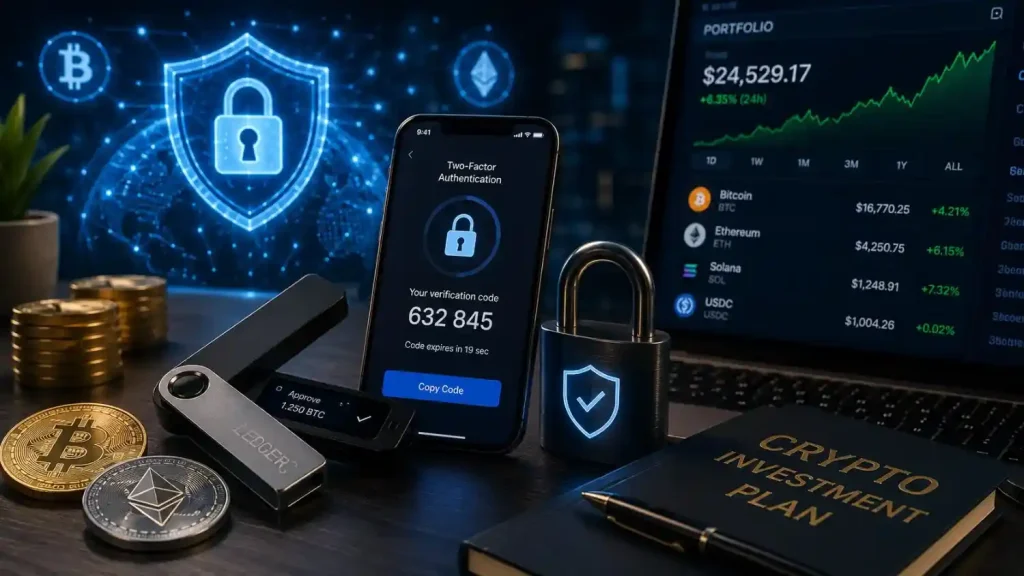
Understanding Private Keys and Seed Phrases
Every crypto wallet generates:
- A private key
- A recovery seed phrase (typically 12 or 24 words)
These are the most important credentials for accessing your funds.
Never:
❌ Share your seed phrase
❌ Store it in cloud storage
❌ Email it to yourself
❌ Take screenshots
❌ Share it with customer support
Instead:
✅ Write it down on paper or a metal backup
✅ Store it in a secure offline location
Anyone with your seed phrase can access your crypto.
Step 10: Build a Diversified Crypto Portfolio
One of the biggest mistakes beginners make is putting all their money into a single cryptocurrency. Even strong projects can experience significant price swings.
Diversification helps spread risk across different types of digital assets.
Example Beginner Portfolio
| Asset | Allocation |
|---|---|
| Bitcoin (BTC) | 45% |
| Ethereum (ETH) | 30% |
| Solana (SOL) | 10% |
| Stablecoins (USDC/USDT) | 10% |
| High-Risk Altcoins | 5% |
This is only an example—not financial advice. Adjust your portfolio according to your risk tolerance and investment goals.
Step 11: Manage Risk Like a Smart Investor
Successful investing isn’t about finding the next coin that could surge overnight. It’s about protecting your capital.
Risk Management Tips
- Invest only money you can afford to lose.
- Keep an emergency fund outside crypto.
- Avoid emotional buying and selling.
- Review your portfolio periodically.
- Rebalance your holdings if one asset grows too large.
- Don’t borrow money to invest in crypto.
- Stay informed about market developments.
Remember: preserving capital is just as important as growing it.
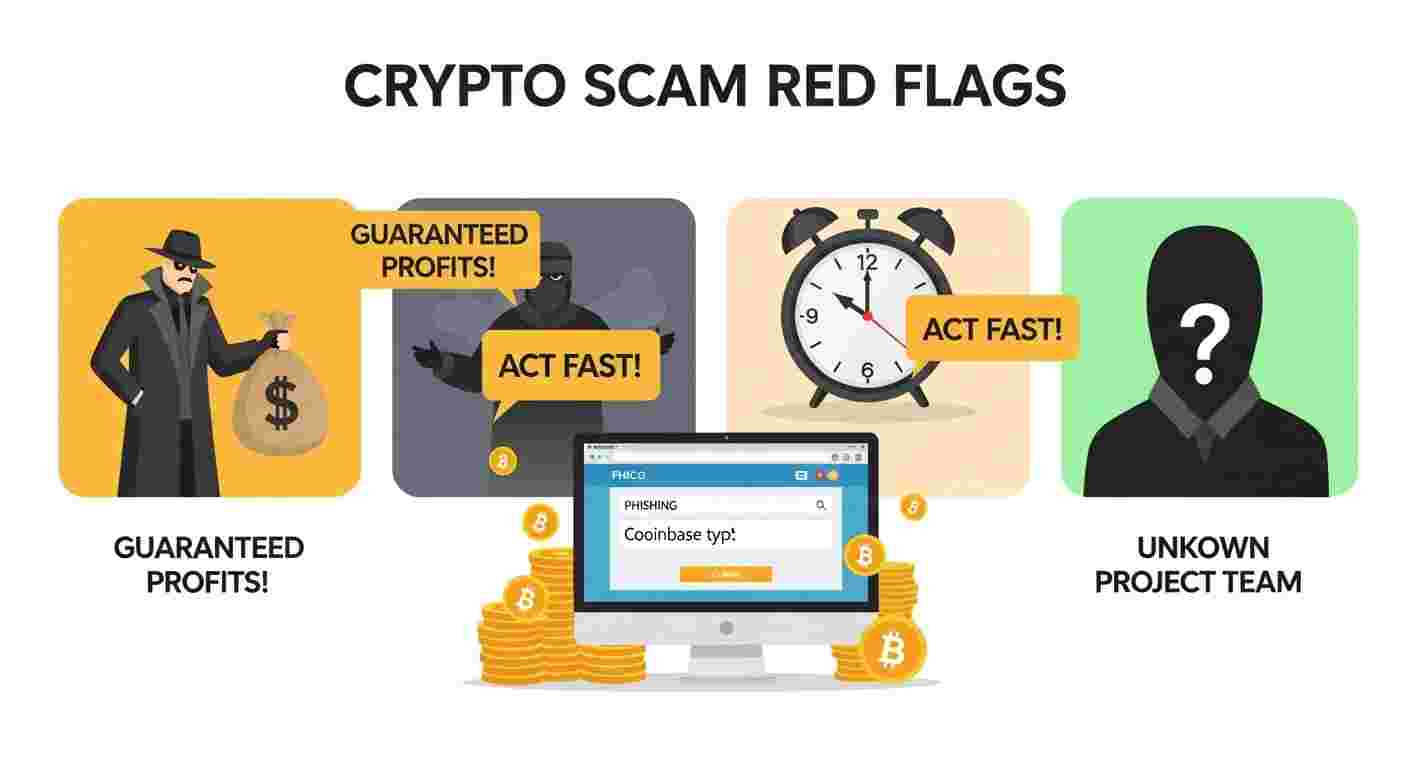
Common Crypto Scams to Avoid in 2026
As cryptocurrency adoption grows, so do scams. Learning to recognize red flags can save you from costly mistakes.
1. Guaranteed Profit Schemes
No legitimate investment can promise fixed or guaranteed returns.
2. Fake Investment Platforms
Fraudulent websites often imitate well-known exchanges to steal your funds or login credentials.
3. Phishing Emails and Messages
Scammers may send emails or messages that look official, asking you to verify your account or reveal your recovery phrase.
4. Fake Giveaways
Be wary of social media posts claiming you’ll receive double the crypto you send.
5. Pump-and-Dump Groups
Some online communities coordinate buying obscure tokens to inflate prices before selling, leaving late buyers with losses.
6. Rug Pulls
Developers abandon a crypto project after collecting investor funds, causing the token’s value to collapse.
Red Flags Every Beginner Should Watch For
If you encounter any of these, proceed with extreme caution:
- Guaranteed returns
- Pressure to invest immediately
- Anonymous development team
- No whitepaper or roadmap
- Fake celebrity endorsements
- Requests for your seed phrase
- Unverified websites
- Unrealistically high staking rewards
If something feels suspicious, take time to research before investing.
Benefits of Investing in Crypto
Cryptocurrency offers several advantages when approached with realistic expectations and sound risk management.
Key Benefits
- Potential for long-term growth
- Easy access with low minimum investment
- Portfolio diversification
- Global accessibility
- Fast cross-border transactions
- Increasing institutional adoption
- Innovation in decentralized finance (DeFi)
- Opportunities for passive income through staking (where appropriate)
Challenges and Risks
Despite its potential, crypto investing involves meaningful risks.
Main Risks
- High price volatility
- Regulatory uncertainty
- Cybersecurity threats
- Scams and fraud
- Technical complexity for beginners
- Market sentiment-driven price swings
- Smart contract vulnerabilities
- Liquidity risks in smaller cryptocurrencies
Understanding these risks helps you make more informed decisions.
Tax Considerations
Cryptocurrency transactions may be taxable depending on your country of residence.
Common taxable events include:
- Selling cryptocurrency
- Trading one crypto for another
- Earning staking rewards
- Mining rewards
- Spending cryptocurrency
Keep accurate records of all transactions, including purchase prices, sale prices, dates, and fees. If your tax situation is complex, consult a qualified tax professional.
Future Outlook for Crypto in 2026
The cryptocurrency industry continues to evolve rapidly. Several trends are shaping its future:
- Greater institutional participation
- Expansion of tokenized real-world assets (RWAs)
- Increased integration of AI and blockchain
- Growth of decentralized finance
- Improved blockchain scalability
- Clearer regulations in many jurisdictions
- Wider adoption of stablecoins for payments
While no one can predict market prices with certainty, blockchain technology is expected to remain an important part of the digital economy.
Final Thoughts
Starting your cryptocurrency investment journey in 2026 doesn’t require large amounts of money or advanced technical knowledge. What matters most is building a strong foundation, investing responsibly, and prioritizing security.
Begin with established cryptocurrencies, choose reputable exchanges, use secure wallets, and adopt a long-term mindset. Avoid chasing hype or making emotional decisions during market swings.
The most successful investors are often those who stay patient, continue learning, and manage risk consistently.
Conclusion
Crypto investing can be rewarding, but it should always be approached with careful research and realistic expectations. By understanding the fundamentals, protecting your assets, and following a disciplined investment strategy, you’ll be in a much stronger position to navigate the evolving crypto landscape.
Whether you’re buying your first Bitcoin or building a diversified portfolio, remember that investing is a marathon—not a sprint.
Did you find this guide helpful? Share it with someone who’s just starting their crypto journey, leave a comment with your questions, and subscribe to ThePulseTime.site for more beginner-friendly crypto insights and market updates.
Question for readers: If you were starting your crypto journey today, which cryptocurrency would you choose first—and why?
Frequently Asked Questions (FAQs)
1. Is crypto a good investment for beginners in 2026?
It can be, provided you start small, invest only what you can afford to lose, and focus on established cryptocurrencies while learning the basics.
2. How much money should I start with?
Many beginners start with a modest amount they are comfortable risking. Consistency is generally more important than the size of the initial investment.
3. Which cryptocurrency is safest for beginners?
Many new investors begin with well-established cryptocurrencies such as Bitcoin and Ethereum due to their larger ecosystems and longer track records.
4. Should I keep my crypto on an exchange?
For long-term holdings, many investors prefer using a secure wallet where they control their private keys instead of leaving all assets on an exchange.
5. What is Dollar-Cost Averaging (DCA)?
DCA is an investment strategy where you invest a fixed amount at regular intervals, regardless of market price, helping reduce the impact of volatility.
6. Can I lose all my money in crypto?
Yes. Cryptocurrency is a high-risk asset class, and prices can fall significantly. Proper research and risk management are essential.
7. How do I avoid crypto scams?
Use reputable exchanges, enable two-factor authentication, never share your seed phrase, verify website URLs, and avoid investments promising guaranteed returns.
8. Is cryptocurrency legal?
Legality varies by country. Check your local regulations before investing or trading.








Leave a Reply