
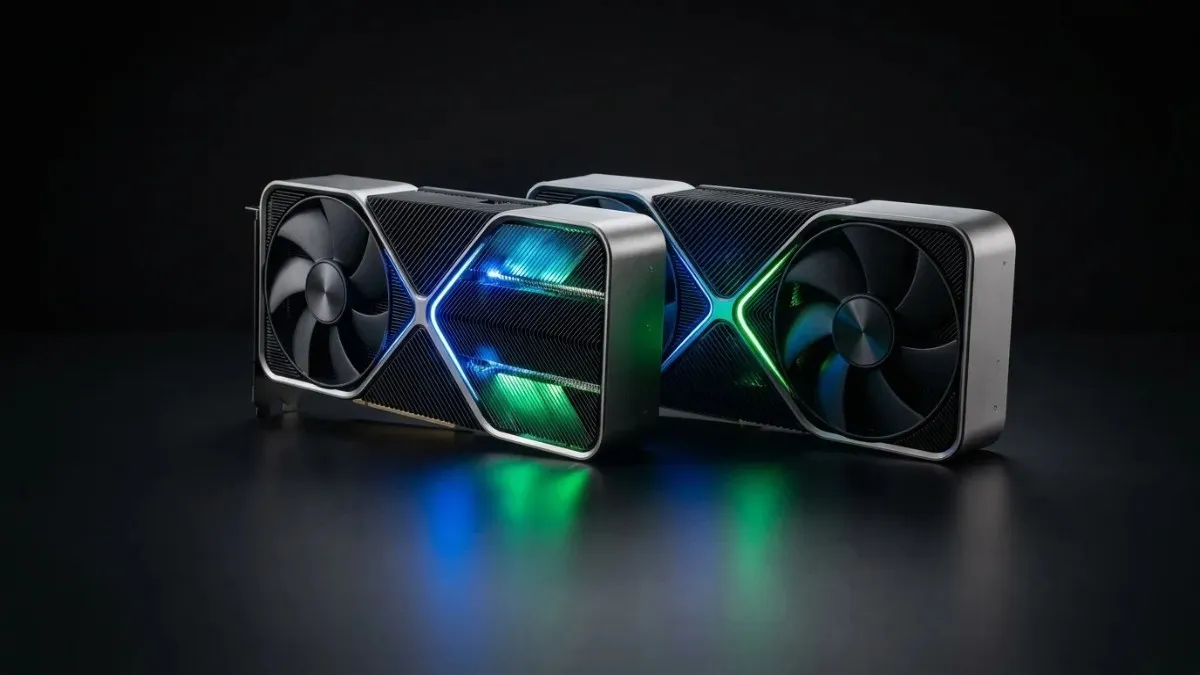
The RTX 5090 vs RTX 4090 debate is the biggest question on every enthusiast’s mind right now — and if you’re trying to decide whether to spend big on Nvidia’s newest flagship or grab its still-mighty predecessor, you’re in exactly the right place. In this guide, we’ll break down the real-world differences in gaming, AI, creative work, price, and power so you can make a confident decision.
Think of this as a friendly chat with someone who’s read all the benchmarks so you don’t have to. We’ll compare specs side by side, look at actual 4K performance numbers, and be honest about where each card makes sense. If you’re new to GPUs, don’t worry — we’ll keep it simple, and you can always brush up on the basics with our guide to how to build a future-proof gaming PC.
What You’ll Learn in This Article
- How the RTX 5090 and RTX 4090 compare on core specs and architecture
- Real native 4K gaming benchmarks and what they mean for you
- Which card wins for AI, machine learning, and content creation
- Whether the price premium and higher power draw are worth it
- Who should upgrade — and who should happily stick with the 4090
RTX 5090 vs RTX 4090: Quick Spec Comparison
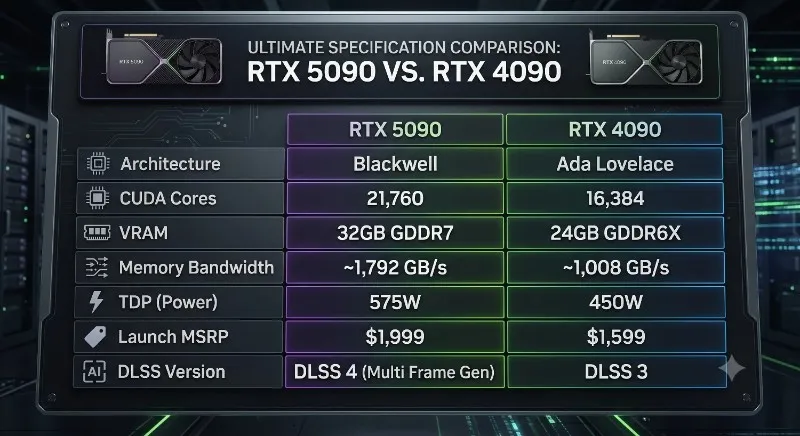
Before we dive into performance, let’s put the two flagships head to head. Nvidia’s RTX 5090 is built on the new Blackwell architecture, while the RTX 4090 uses the older but proven Ada Lovelace design.
| Specification | RTX 5090 | RTX 4090 |
|---|---|---|
| Architecture | Blackwell | Ada Lovelace |
| CUDA Cores | 21,760 | 16,384 |
| VRAM | 32GB GDDR7 | 24GB GDDR6X |
| Memory Bandwidth | ~1,792 GB/s | ~1,008 GB/s |
| TDP (Power) | 575W | 450W |
| Launch MSRP | $1,999 | $1,599 |
| DLSS Version | DLSS 4 (Multi Frame Gen) | DLSS 3 |
That’s a big jump in raw resources. The RTX 5090 packs roughly 33% more CUDA cores, a full 8GB of extra VRAM, and a huge leap in memory bandwidth. According to Nvidia’s official GeForce RTX 5090 product page, the card is positioned as “the most powerful GeForce GPU ever made.”
Real-World Gaming: How Big Is the Gap?
Specs are one thing, but frames per second are what actually matter when you’re gaming. So how do these two behave in the real world?
At native 4K, testing across 20 of the most demanding modern games shows the RTX 5090 is about 33% faster than the RTX 4090 on average. That’s a meaningful generational leap, though not the “double the performance” some people hoped for. DSOGaming
Here’s the interesting part: the higher the resolution, the bigger the lead. At 1080p or 1440p, you’ll often be CPU-bottlenecked, so the gap shrinks. But at 4K, 5K, and especially ultra-high-resolution VR setups, the RTX 5090’s extra bandwidth and cores stretch their legs. Some VR users testing at extreme resolutions have reported the 5090 pulling far ahead when the 4090 simply runs out of headroom.
The DLSS 4 Advantage
One of the biggest separators is software. The RTX 5090 supports DLSS 4 with Multi Frame Generation, which can generate multiple AI frames for every rendered frame — dramatically boosting smoothness in supported titles. The RTX 4090 is locked to DLSS 3. In DLSS 4-enabled games, the perceived performance gap can feel much larger than the raw hardware numbers suggest.
AI and Content Creation: Where the 5090 Really Shines
If you do more than game, the story gets even more compelling. That extra VRAM and bandwidth are gold for AI workloads and heavy creative apps.
For AI inference, benchmarks show the RTX 5090 delivering around 3,500 tokens/second vs 2,550 tokens/second on the RTX 4090 for Llama 3.1 8B in FP16 — thanks largely to the 78% memory bandwidth advantage. The 32GB of VRAM also lets it handle larger models (13B–32B) that simply won’t fit on the 4090’s 24GB. Spheron
For video editors, 3D artists, and Blender users, the extra CUDA cores and memory translate to faster renders and the ability to work with bigger, more complex scenes without hitting memory limits.
✦ Benefits of Upgrading to the RTX 5090
- Superior 4K/8K gaming with 30–35% higher native performance
- 32GB GDDR7 for future-proofing and demanding creative/AI work
- DLSS 4 Multi Frame Generation for exclusive smoothness gains
- Massive memory bandwidth ideal for AI, ML, and rendering
- Best-in-class for anyone who wants absolutely no compromises
✦ Challenges and Risks to Consider
Let’s be real — the RTX 5090 isn’t for everyone, and there are genuine downsides.
- High price: At a $1,999 MSRP (and often more at retail), it’s a serious investment.
- Power hungry: A 575W TDP means you’ll likely need a 1000W+ PSU and strong cooling.
- Availability: Over a year after launch, stock can still be tight and prices inflated.
- Diminishing returns at lower resolutions: If you game at 1080p or 1440p, you may not see the full benefit due to CPU bottlenecks.
If you’re weighing the cost-versus-benefit carefully, it’s worth reading our breakdown of best PC hardware tools and resources for 2026 to plan your build budget wisely.
✦ Future Outlook
The RTX 5090 sits in a class of its own. With AMD and Intel focusing on the midrange and budget segments, Nvidia’s flagship has no direct competitor — meaning its performance crown (and premium pricing) is likely to hold for a while. As more games adopt DLSS 4 and AI workloads grow ever larger, the 5090’s advantages should become more pronounced over time, making it a stronger long-term buy for power users who plan to keep their GPU for several generations.
The Bottom Line
So, RTX 5090 vs RTX 4090 — which should you choose? If you game at 4K or higher, do serious AI or creative work, and want the absolute best with no compromises, the RTX 5090 is a clear and worthwhile upgrade. But if you already own a 4090, or you game at 1080p/1440p, the older flagship remains an incredible performer that still crushes almost everything — and it now often comes at a lower price.
Choose the 5090 for future-proofing and peak performance; stick with the 4090 for outstanding value.
Did this comparison help you decide? Drop a comment below with which card you’re leaning toward, share this guide with a fellow PC enthusiast, and subscribe to the ThePulseTime newsletter for the latest hardware deep-dives. And here’s a question to chew on: as AI workloads keep growing, do you think 32GB of VRAM will still feel like “enough” two years from now?
2. FAQs
1. Is the RTX 5090 worth it over the RTX 4090? For 4K/8K gamers, AI users, and creators, yes — the roughly 33% performance gain, 32GB VRAM, and DLSS 4 justify the upgrade. For 1080p/1440p gamers or current 4090 owners, the value is weaker.
2. How much faster is the RTX 5090 than the RTX 4090? On average, about 30–35% faster in native 4K gaming, with larger gains at higher resolutions and in DLSS 4-enabled titles.
3. How much VRAM does the RTX 5090 have? The RTX 5090 has 32GB of GDDR7 memory, compared to 24GB of GDDR6X on the RTX 4090.
4. What power supply do I need for an RTX 5090? With a 575W TDP, Nvidia and most system builders recommend a high-quality 1000W or higher PSU.
5. Does the RTX 4090 support DLSS 4? The RTX 4090 supports DLSS 3 but not the full DLSS 4 Multi Frame Generation feature, which is exclusive to the Blackwell RTX 50 series.
6. Is the RTX 5090 good for AI and machine learning? Yes. Its 32GB VRAM and ~1,792 GB/s bandwidth make it excellent for running larger models and faster inference than the 4090.
7. What is the price difference between the RTX 5090 and RTX 4090? The RTX 5090 launched at $1,999 MSRP versus $1,599 for the RTX 4090, though street prices vary with availability.
8. Should I wait for a future GPU instead of buying now? If your current card meets your needs, waiting is fine. But the RTX 5090 currently has no direct competitor and should stay relevant for several years.

Leave a Reply